




Showing posts with label darwin. Show all posts
Showing posts with label darwin. Show all posts
Sunday, February 21, 2010


Monday, February 8, 2010
Biography of Charles Darwin | Janet Browne's Stanford Lecture
LECTURE DESCRIPTION
Dr. Janet Browne presents a biography on Charles Darwin and explores Darwin's Origin of Species. The lecture is concluded with a panel discussion with Craig Heller and Robert Proctor.
This is the third lecture in the Stanford course on Darwin's Legacy I've been sharing here recently (see parts 1 and 2), and is a good one to start off this week with, as we prepare to celebrate Darwin's 201st birthday next Friday. Janet Browne, of course, is the author of what may be the definitive biography of Darwin, published in two volumes: Voyaging and The Power of Place. Click on those links to pick up your copy if you haven't read them yet - this wonderful biography of a truly remarkable scientist belongs in every respectable library! And I particulary urge those of you who are troubled by evolution and may be suspicious of the old man to set aside your prejudices and read these books to appreciate the fullness of his life and work even if its implications trouble you!
Wednesday, January 27, 2010
Genie Scott on Evolution Versus Creationism
This is the second lecture of the course on Darwin's Legacy offered at Stanford in 2008. I posted the first lecture earlier today.
Darwin's Legacy: introduction to a course from Stanford University
On NCSE's Facebook page this morning I discovered a link to this wonderful series of lectures on Darwin's Legacy put together as a continuing education course by Stanford University in fall 2008. I will post the whole series here, since it has recently become available online. Or you can get a jump start and go to the source: watch the whole thing in YouTube videos like the one above on Academic Earth or download it to your favorite portable device by downloading it from iTunes U.
While we don't have Stanford's resources or reach, as you may know, we are nevertheless also hosting our own modest Evolutionary Biology Lecture Series under the umbrella of the Consortium for Evolutionary Studies at California State University, Fresno this year. And as some of you may remember, we had NCSE's Dr. Eugenie Scott speaking on campus last month; she's also featured as the second talk in the Stanford course. This friday we'll learn about the evolution of the vertebrate blood coagulation system from Dr. Russell Doolittle of UC San Diego. Join us if you can, or come back here for videos/podcasts - I will try to record and post as many as I can.
NOVA | Darwin's Darkest Hour
via pbs.org
While the big cinema treatment of Darwin's great pause in publishing "On the Origin of Species" may never make it down to theatres in our neck of the woods, out here in California's Central Valley (not a big market for stories about Darwin, it seems!), the above version on PBS' Nova was actually quite compelling. Having read some mixed reviews of Creation (although most reviews have been positive), I wonder if this televisual treatment may actually be superior in capturing the remarkable intellectual ferment behind Darwin's work. Rather than the movie's dramatic emphasis (from what I've read) on the emotional drama of Darwin's life after the death of little Annie, this Nova biopic choses to focus more on the intellectual turmoil (without downplaying the emotional turmoil at all), and even has Charles and Emma going back and forth in a very compelling way as he develops his arguments. If you're fortunate to be living in a place where Creation was released in theatres (or have managed to score a copy to view somehow), I'd love to know what you think: how does this compare?
Sunday, January 3, 2010
An evolutionary retrospective on 2009 from rapper Baba Brinkman
Our favorite evolved rapper, Baba Brinkman, who had us rapt in Fresno last February with his Rap Guide to Evolution, offers his retrospective of the just concluded year when we celebrated Charles Darwin's Bicentennial, and the sesquicentennial of a little book he wrote:
Neo-simians,In the final hours of 2009, let us take a moment to reflect on this: up until 150 years ago, no one had the faintest idea why we look like we do, why we act like we do, or where we came from. Now we know, and we have Charles Darwin to thank. Three cheers!
Posted via web from a leaf warbler's gleanings
Thursday, December 31, 2009
Welcome 2010 International Year of Biodiversity: What Darwin Never Knew (full video)
via video.pbs.org
Lo and behold: the full video of the NOVA documentary is available for your viewing pleasure online - enjoy! Its a great way to start 2010, the International Year of Biodiversity.
Posted via web from a leaf warbler's gleanings
Wednesday, December 30, 2009
So what did Darwin never know? Evo-devo, of course!
It was two hours well spent watching the PBS NOVA special What Darwin Never Knew last night, and I was thinking of a longer post about it when I discovered that good ol' PZ was actually live-blogging during the show! I had considered that too, but quickly given up because my limited multitasking abilities were already stretched thin between watching the show and keeping our 4-year-old entertained (something PZ no longer has to worry about I reckon). In any case, I quite agree with his assessment of the show, particularly this bottom line:
My opinion overall: the first half hour was boring to me — it was an extremely basic primer in old-school Darwinian biology. The middle hour was of more interest, and did get into real evolutionary developmental biology, and showed off some of the best examples of work in the field. This was the bit I'd find most useful in my classes; that first half-hour was too basic for most freshman biology majors.
I wasn't too keen on the last bit where it got very human-centric, but I can see where the examples they talked about would provoke viewer interest. I just wish it were possible for the medium to push a little deeper into the topics than they did.So if you missed it, head on over to the NOVA website and check it out. And if you are taking my classes this spring, you may well see a clip or two in there.
Carroll, Shubin, and Tabin were good. Make them TV stars!
Tuesday, December 29, 2009
Tonight on NOVA: What Darwin Never Knew
via youtube.com
Just getting ready to watch this 2-hr documentary on PBS NOVA tonight. But in looking for this clip on YouTube, I found a British series titled "What Darwin didn't know" - sounds intriguing, and I may share it here later.
Posted via web from leafwarbler's posterous
Wednesday, October 21, 2009
Darwin's Brave New World - Extended Trailer
Does this look exciting, or what? That trailer sure sucked me in much more energetically than either of the trailers for Creation or Darwin's Darkest Hour. Hopefully the whole thing delivers on what the trailer promises. Too bad, therefore, not to see any US air dates at the end there, although our neighbors to the north will get to see it, having helped produce it. I hope it does get here eventually. PBS, are you paying attention?
Friday, October 9, 2009
Thoughts on "The Origin Cycle", or why does the Darwinian vision evoke darkness?

I've wondered about this for some time now, especially since the Darwin Day discussion panel we hosted on our campus last spring, when the philosopher on the panel brought up the not uncommon view that Darwin somehow displaced morality and left us morally and ethically adrift! And how many in the audience agreed, with even evolutionists on the panel nodding sadly to acknowledge the loss of moral innocence engendered by Darwin. (And I'm apprehensive about the new Darwin biopic "Creation" for it too may be too bleak.)
These questions disturb me again now since last night's performance of "The Origin Cycle " a musical performance of eight selections from "On the Origin of Species" at Stanford University. Let me state first off that I am no music critic (even my iPod listening tends towards spoken word podcasts/books rather than music), and that this particular genre of music is rather outside my normal listening sphere (and don't even ask me what this genre is!). So consider this more a response to the emotions evoked in me by the music, and my subsequent intellectual response to those emotions. I found the concert and performances quite wonderfully evocative - even though our 9-yr-old Darwin fan fell asleep after failing to track the words being sung by the soprano Jane Sheldon; she was still impressed enough to want to meet the musicians and get their autographs on the program! As the friend who invited us to the concert remarked, the compositions were quite complex musically - and appropriately so, I thought, given the subject. So the music did capture the chosen text quite well (I'll share the passages featured later tonight when we return to Fresno), but - and I can't quite put the finger on the role of any particular element in this - I felt the general emotional tone was on the darker side, with melancholy washing over me far more than joy. No wonder then, that the one upbeat composition in the middle, set to a passage about the "Tree of Life" really lifted me up, but all too briefly, before the mood became sombre again. I was hoping for more uplift towards the end, with the final two pieces revolving around Darwin's immortal words about the "Entangled Bank" and the grandeur in this view of life (Floreana) - but those compositions were darker too. The conductor, Jeffrey Means, later told me that "Tree of Life" was the ensemble's favorite too - but I didn't get the chance to ask him about the darkness of the other pieces. So I am left with the sense that the composers of these creative pieces too share a darker view of the meaning of Darwin's work even as they celebrate it. I, for one, would prefer more joy, and more thrill at the sheer intellectual adventure of Darwin, as seen in this week's Nova special on "Darwin's Darkest Hour", which was less dark than the title suggested - but perhaps I should leave that review for a separate post.
Tuesday, October 6, 2009
The Origin Cycle - selections from Darwin's classic set to music at Stanford this thursday!
Charles Darwin's Origin of Species is not only one of the most important scientific works of all time, but one of the most beautifully written. In The Origin Cycle, eight contemporary composers set fragments of Darwin's great book to music, for performance by solo soprano and chamber ensemble.
The passages chosen encompass the entire work, capturing the many facets of a Darwinian view of nature, and summarizing what Darwin called the "one long argument" contained in the Origin. They include his most famous and enduring images – the growing "tree of life" connecting all species, the vision of nature as an surface into which wedges are unceasingly struck, and the book's final invocation of "grandeur in this view of life."
The works were commissioned by Jane Sheldon and Peter Godfrey-Smith and funded by the Australian Government through the Australia Council, its arts funding and advisory body.
Although not quite in the Bay area, we are just about within driving range (well, a 3-4 hr drive) to be sorely tempted by this. A friend who lives in the vicinity has already invited us to come for the show and stay over - and our 4th grader Darwinista daughter is sorely tempted to accept that invitation, even if it means playing hooky from school the next day! So it looks like we might be heading that way...
(and as a bonus, I might get to meet Dr. Free-Ride too!)
Darwin's Darkest Hour - on television tonight!
I'm looking forward to watching this on our local public television channel tonight - starting in another half hour here: "Darwin's Darkest Hour" a 2-hour dramatization of "the delay" in publishing his revolutionary theory, which I mentioned last week. Check it out - although this reminder may be too late for those of you living east of California. But don't worry if you miss the broadcast, for you can still watch it online, on the PBS website, and soon on their YouTube channel! Meanwhile, here's another preview:
Thursday, September 24, 2009
Darwin on American Public TV and in Theatres this fall!
As the Darwin Bicentennial year winds down and we approach the Sesquicentennial anniversary of the publication of "On the Origin of Species" on Nov 21, we will get two promising televisual/cinematic treatments of the torment Darwin underwent while sitting on the horns of the dilemma of whether or not to share his theory with the world! The recent drama about whether the movie Creation was going to be distributed at all in the US has now been settled as we get word today that Newmarket, a small Indie company (whose previous hit, intriguingly, was "The Passion of the Christ"!!) has picked up the US rights for the film and plans a year-end release! Hooray - although some of us are apprehensive about how "even-handed" the film will be in trying to "balance" between religion and science! The National Center for Science Education's executive director Eugenie Scott (who has just accepted my invitation to speak at Fresno State this fall as well - but more on that soon!) liked the film, describing it in her early review as "a thoughtful, well-made film that will change many views of Darwin held by the public — for the good."
Meanwhile, NCSE also alerts us to another treatment of Darwin's Darkest Hour - a 2-hour television special airing on PBS stations next week courtesy of NOVA and National Geographic. Here's a preview:
Monday, September 21, 2009

Friday, September 18, 2009
The Evolution of the Origin visualized
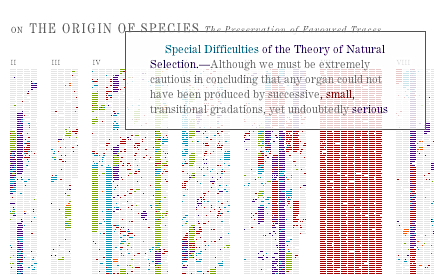
My students know I never tire of emphasizing the self-corrective nature of science: how scientific theories are always dynamic theories, constantly being tested against reality, discarded if they fail the test, and continuously revised and refined as we get a better and better approximation of truth. A good example of a scientist who put his own ideas, his life's work, through this process of continual testing and refinement is of course, Charles Darwin. We all know about how he hesitated to publish his theory of evolution by natural selection for c.20 years, 15 of those after he had written out a detailed "outline", but his work didn't stop with the publication of On the Origin of Species in 1859 (we're coming up on the 150th anniversary of its publication in November this year). He continued to tinker with the book, tweaking the language, refining his arguments, and responding to criticisms as well by eventually adding a whole chapter on the subject - and publishing a total of 6 editions of the book over the next 13 years. Students taking Evolution at Fresno State have in recent years been reading the 1st edition of the classic book, chosen because we want them to experience the book as the world first encountered it, before Darwin had to worry about responding to critics. But the 6 editions themselves represent an evolution of sorts, with favored passages being preserved and refined while others were selected out. Darwin scholars have been studying the differences, and now the rest of us also have a new way to appreciate this textual evolution, through a fascinating new visualization created by Ben Fry of Seed Visualization's Phyllotaxis lab. This dynamic Flash graphic takes you through all the changes to the text much the same way a phylogeneticist might compare DNA sequence changes across a taxon's evolutionary lineage. And as you can see in the gel-like excerpt I've put at the top of this post, you can click on any "band" in any portion of the text-gel to read the mutations therein! Go check it out - its really cool! And read also Ben Fry's interview in Seed about this visualization.
Wednesday, September 16, 2009
When Hollywood distributors are exposed to Darwin's thoughts, who knows what could happen?!
Its not clear yet if and how the Darwin biopic "Creation" may ever get distributed in the US, even as it readies for a UK release next week. There was some scuttlebutt yesterday when the NCSE tweeted a Bay Area NBC affiliate station's report that their parent company was in a "bidding war" over the US distribution rights! And the juicy tidbit in that story was that apparently Mel Gibson (he who managed to get his graphic movie about a guy being flogged and tortured for hours shown in churches all over the US, without the help of any major Hollywood distributors!) had actually helped finance this movie (him being Catholic, and Catholics saying they don't have a problem with Evolution - that's how some people tried to explain it)! Wow - would that have blown some fuses in the heads of the church-going fans of Gibson's Passion in the American heartlands!! But, alas, that won't happen, because that news story has been retracted/replaced, with this caveat:
The original article confused the film's distributor, Icon Distribution, with Mel Gibson owed [sic] Icon Productions. The companies use the exact same logo and indeed Icon Distribution was once owned by Gibson. It is no longer. We regret the error.
Huh?! Alrighty then... and so American journalism continues its reverse evolution - but that disease apparently afflicts the British press as well, for the very same Telegraph that lamented the lack of a US distributor for this movie had, two days earlier, published a truly egregious piece of "balanced" reporting about evolution vs. creationism! As for the movie itself, I still haven't seen any official word on how that NBC affiliate's parent company is doing in that "bidding war", nor if indeed there is any such war at all. In fact, their own latest story has no mention of any bidding!! Scores of fans on the movie's Facebook page, meanwhile, are rallying around demanding it be shown here, but who knows if they constitute enough of a market for the bean counters weighing faith-based backlash vs. the box office appeal of a 19th century nerd wrestling with serious scientfic/philosophical issues! Last night, on another media outlet likely genetically linked to the Bay Area station, Rachel Maddow and Kent Jones had probably the funniest take on the saga:
Sunday, September 13, 2009
Who will dare show this in America?
These are strange and deeply worrisome times for democracy, science, and education in America, once the beacon of those very things which drew people like me from all over the world to its shores. From a global leader for science and free intellectual pursuits, how has America become a place where even one of the most significant scientists in human history is no longer welcome? Not even a biographical film about him! In a week when this country's very own democratically elected President was censored in the nation's public schools and heckled by a congressman, this news should come as no surprise, I suppose:
Creation, starring Paul Bettany, details Darwin's "struggle between faith and reason" as he wrote On The Origin of Species. It depicts him as a man who loses faith in God following the death of his beloved 10-year-old daughter, Annie.
The film was chosen to open the Toronto Film Festival and has its British premiere on Sunday. It has been sold in almost every territory around the world, from Australia to Scandinavia.
However, US distributors have resolutely passed on a film which will prove hugely divisive in a country where, according to a Gallup poll conducted in February, only 39 per cent of Americans believe in the theory of evolution.
Movieguide.org, an influential site which reviews films from a Christian perspective, described Darwin as the father of eugenics and denounced him as "a racist, a bigot and an 1800s naturalist whose legacy is mass murder". His "half-baked theory" directly influenced Adolf Hitler and led to "atrocities, crimes against humanity, cloning and genetic engineering", the site stated.
The film has sparked fierce debate on US Christian websites, with a typical comment dismissing evolution as "a silly theory with a serious lack of evidence to support it despite over a century of trying".
Jeremy Thomas, the Oscar-winning producer of Creation, said he was astonished that such attitudes exist 150 years after On The Origin of Species was published.
"That's what we're up against. In 2009. It's amazing," he said.
"The film has no distributor in America. It has got a deal everywhere else in the world but in the US, and it's because of what the film is about. People have been saying this is the best film they've seen all year, yet nobody in the US has picked it up.
"It is unbelievable to us that this is still a really hot potato in America. There's still a great belief that He made the world in six days. It's quite difficult for we in the UK to imagine religion in America. We live in a country which is no longer so religious. But in the US, outside of New York and LA, religion rules.
"Charles Darwin is, I suppose, the hero of the film. But we tried to make the film in a very even-handed way. Darwin wasn't saying 'kill all religion', he never said such a thing, but he is a totem for people."
Creation was developed by BBC Films and the UK Film Council, and stars Bettany's real-life wife Jennifer Connelly as Darwin's deeply religious wife, Emma. It is based on the book, Annie's Box, by Darwin's great-great-grandson, Randal Keynes, and portrays the naturalist as a family man tormented by the death in 1851 of Annie, his favourite child. She is played in the film by 10-year-old newcomer Martha West, the daughter of The Wire star Dominic West.
Early reviews have raved about the film. The Hollywood Reporter said: "It would be a great shame if those with religious convictions spurned the film out of hand as they will find it even-handed and wise."
Mr Thomas, whose previous films include The Last Emperor and Merry Christmas Mr Lawrence, said he hoped the reviews would help to secure a distributor. In the UK, special screenings have been set up for Christian groups.
And you thought the money-grubbing, amoral (or immoral), Hollywood movie business loved controversy and liked to make a buck off it whenever it could! Apparently not, if it might irritate a minority (I hope) of religious extremists, America's own Taliban. So a film about Darwin - a long dead and much celebrated scientist - seems much more dangerous to the fabric of this country than Borat! Sigh...
Sunday, August 23, 2009
Science knows it doesn't know everything... and neither did Darwin
A couple of interesting examples of the self-correcting nature of Science today:

The human vermiform (“worm-like”) appendix is a 5–10 cm long and 0.5–1 cm wide pouch that extends from the cecum of the large bowel. The architecture of the human appendix is unique among mammals, and few mammals other than humans have an appendix at all. The function of the human appendix has long been a matter of debate, with the structure often considered to be a vestige of evolutionary development despite evidence to the contrary based on comparative primate anatomy. The appendix is thought to have some immune function based on its association with substantial lymphatic tissue, although the specific nature of that putative function is unknown. Based (a) on a recently acquired understanding of immune-mediated biofilm formation by commensal bacteria in the mammalian gut, (b) on biofilm distribution in the large bowel, (c) the association of lymphoid tissue with the appendix, (d) the potential for biofilms to protect and support colonization by commensal bacteria, and (e) on the architecture of the human bowel, we propose that the human appendix is well suited as a “safe house” for commensal bacteria, providing support for bacterial growth and potentially facilitating re-inoculation of the colon in the event that the contents of the intestinal tract are purged following exposure to a pathogen. (emphasis added)
Now we have a broader comparative phylogenetic analysis by Smith et al (incl. two of the authors of the 2007 paper) where they looked at the distribution of similar structures across the mammalian phylogeny to report:
A recently improved understanding of gut immunity has merged with current thinking in biological and medical science, pointing to an apparent function of the mammalian cecal appendix as a safe-house for symbiotic gut microbes, preserving the flora during times of gastrointestinal infection in societies without modern medicine. This function is potentially a selective force for the evolution and maintenance of the appendix, and provides an impetus for reassessment of the evolution of the appendix. A comparative anatomical approach reveals three apparent morphotypes of the cecal appendix, as well as appendix-like structures in some species that lack a true cecal appendix. Cladistic analyses indicate that the appendix has evolved independently at least twice (at least once in diprotodont marsupials and at least once in Euarchontoglires), shows a highly significant (P < 0.0001) phylogenetic signal in its distribution, and has been maintained in mammalian evolution for 80 million years or longer.
How exciting: the appendix has evolved and been maintained multiple times among different mammal lineages likely because if confers some selective advantage; and it continues to serve a useful function in the human body too! Tell that to the surgeon who offers to remove yours as an elective procedure while he has you opened up for some other reason (e.g. a cesarean section)!
So Darwin, who didn't know about appendix like structures in other mammals, and didn't have access to phylogenetic analyses of the sort that is routine these days, wrote that the appendix was useless, and even a cause of death (which it still is sometimes, when infected). A classic "vestigial" organ. Now we know he was wrong - as he was about some other things too; but not about his theory of evolution by natural selection. As I try to impress upon my students every year, scientists have been trying to prove Darwin wrong for 150 years, but have only ended up strengthening the evidence for his theory of evolution. So it is only natural that when someone finds something, anything, in the details that Darwin was wrong about, there is some excitement. Understandable, really, for this is how science works - we don't venerate our authority figures, but try to prove them wrong, and respect only those theories that can withstand such relentless questioning. What I don't understand, however, is PZ's reaction over on Pharyngula, where he's taken the authors of these studies to task for suggesting Darwin was wrong! Surely PZ knows better - even Darwin would have reveled in the evidence we now have, and gladly accepted his error! So I share my bafflement over PZ's rather odd interpretation of what is "vestigial" with Bjørn Østman of Pleiotropy. If an organ has a function that contributes to current fitness, its hardly "vestigial" now, is it?.
And those that berate us as adherents of "scientism" or "Darwinism", take note: we are quite happy to prove even Darwin wrong, and not afraid to stand up to the fierce atheist PZ neither! (and may PZ's octopod friends and minions never find this obscure little blog...)
2. The other example of science's self correcting ways comes in the form of a mea culpa by L. David Mech, the leading wolf expert who once suggested that wolf packs are organized in dominance hierarchies with "alpha males" leading the pack - except that most natural wolf packs aren't like that at all! Having continued studying wolves for some 4 decades since he suggested the "alpha male" notion, and increasingly concerned about the population status of wolves in the wild, Mech now admits he was wrong about their social organization, and would like to undo the damage his initial descriptions may have caused to the wolf's reputation.
His initial conclusions were biased by studies of artificial wolf groups in captivity, where such dominance hierarchies formed; in natural packs, familial relationships and lineage play a bigger role than combat for leadership (sound familiar?). Mech, therefore, would like us to stop using the "alpha male" terminology which has taken a metaphoric life of its own in popular culture.
And rather unlike its depictions in said popular culture, this is exactly how science is supposed to work: through constant self-examination and self-correction! So let me leave you with another video, from a British comedian, who puts it best: "Science Knows It Doesn't Know Everything, Otherwise It Would Stop". Let that be the take-home message this Sunday; and don't stop the questioning!
References:
Randal Bollinger, R., Barbas, A., Bush, E., Lin, S., & Parker, W. (2007). Biofilms in the large bowel suggest an apparent function of the human vermiform appendix Journal of Theoretical Biology, 249 (4), 826-831 DOI: 10.1016/j.jtbi.2007.08.032
SMITH, H., FISHER, R., EVERETT, M., THOMAS, A., RANDAL BOLLINGER, R., & PARKER, W. (2009). Comparative anatomy and phylogenetic distribution of the mammalian cecal appendix Journal of Evolutionary Biology DOI: 10.1111/j.1420-9101.2009.01809.x
Wednesday, March 4, 2009
God, Darwin, and the Culture Wars - Ethics Center Lecture
Today, at noon, the Ethics Center Lecture series @ CSU-Fresno will plunge into the culture wars with the following lecture:
March 4: Leonard Olson, God, Darwin, and the Culture Wars
12-12:50 PM in the Alice Peters Auditorium (in the University Business Center)
Most observers would agree that there is something like a cultural war taking place in America today, especially over the question of the origins of life on Earth. Is the choice as simple as one between evolution or creation? Extremists on both sides frame the issue poorly. As a result, a reasonable middle position is ignored. This talk will examine the middle and criticize the extremes.
Leonard Olson is a Lecturer in the Department of Philosophy at CSU-Fresno, where he has been teaching ethics courses since 1986. A native of the Central Valley, he was educated at San Francisco State and U. C. Davis.
Subscribe to:
Posts (Atom)

 Posts
Posts


