Showing posts with label history. Show all posts

Wednesday, June 16, 2010

Evolving Thoughts on Homology


Accompanying the above intriguing illustration, John Wilkins has written a really good essay on the concept of homology, which we are taught (and go on to teach) as a really basic concept in evolution, but has surprising ambiguities and potential circularities (not unlike a few other evolutionary terms I can think of). John very helpfully traces some of the history of the term, and how its application has evolved as we've become better at building and testing phylogenies as hypotheses of evolutionary relationships. I have to agree with him when he says:
The notion of homology is complex, and as we recently saw when I asked about the use in mathematics, it has a slew of other meanings, but the one that seems to me to be consistent across all uses is this: a homology is a mapping or “agreement” of parts of organisms with other parts of organisms. A mapping relation is not a similarity, and it is not the explanation of the relation (such as evolutionary common ancestors, which are proposed to explain the homology). It is an identity relation: this is the same as that. The identity may be an identity of place, of sequence, of developmental process, or just of a shared name, but what it is not is similarity or common ancestry. Similarity may be how we identify homology (and what kinds of similarity depends on what we use), and common ancestry may be how we explain homology, but in both cases homology is the relation itself.
You know you'll be reading the rest of that essay for sure if you are in my class the next time I teach Evolution!

Read More...

Wednesday, March 17, 2010

Rebecca Skloot brings Henrietta Lacks to the Colbert Nation

I'm still reading Skloot's fascinating account The Immortal Life of Henrietta Lacks, which I started reading during Black History Month, and will finish soon before Women's History Month ends.

Posted via web from a leaf warbler's gleanings

Read More...

Monday, February 8, 2010

Biography of Charles Darwin | Janet Browne's Stanford Lecture

LECTURE DESCRIPTION
Dr. Janet Browne presents a biography on Charles Darwin and explores Darwin's Origin of Species. The lecture is concluded with a panel discussion with Craig Heller and Robert Proctor.

This is the third lecture in the Stanford course on Darwin's Legacy I've been sharing here recently (see parts 1 and 2), and is a good one to start off this week with, as we prepare to celebrate Darwin's 201st birthday next Friday. Janet Browne, of course, is the author of what may be the definitive biography of Darwin, published in two volumes: Voyaging and The Power of Place. Click on those links to pick up your copy if you haven't read them yet - this wonderful biography of a truly remarkable scientist belongs in every respectable library! And I particulary urge those of you who are troubled by evolution and may be suspicious of the old man to set aside your prejudices and read these books to appreciate the fullness of his life and work even if its implications trouble you!

Posted via web from a leaf warbler's gleanings

Read More...

Tuesday, February 2, 2010

The immortal HeLa cells and their source, Henrietta Lacks

ABC World News aired this story last Sunday, which includes a short interview clip with Rebecca Skloot, whose book The Immortal Life of Henrietta Lacks is just hitting the stores. And yes, the woman's name is Lacks - but lame as it seems, the ABC website and video have misspelt it!! The story itself is quite remarkable, and really well told. I will try to post a review of the book here as I'm hoping to finish reading it soon.

Posted via web from a leaf warbler's gleanings

Read More...

Wednesday, January 27, 2010

Darwin's Legacy: introduction to a course from Stanford University

On NCSE's Facebook page this morning I discovered a link to this wonderful series of lectures on Darwin's Legacy put together as a continuing education course by Stanford University in fall 2008. I will post the whole series here, since it has recently become available online. Or you can get a jump start and go to the source: watch the whole thing in YouTube videos like the one above on Academic Earth or download it to your favorite portable device by downloading it from iTunes U.

While we don't have Stanford's resources or reach, as you may know, we are nevertheless also hosting our own modest Evolutionary Biology Lecture Series under the umbrella of the Consortium for Evolutionary Studies at California State University, Fresno this year. And as some of you may remember, we had NCSE's Dr. Eugenie Scott speaking on campus last month; she's also featured as the second talk in the Stanford course. This friday we'll learn about the evolution of the vertebrate blood coagulation system from Dr. Russell Doolittle of UC San Diego. Join us if you can, or come back here for videos/podcasts - I will try to record and post as many as I can.

Posted via web from a leaf warbler's gleanings

Read More...

NOVA | Darwin's Darkest Hour

While the big cinema treatment of Darwin's great pause in publishing "On the Origin of Species" may never make it down to theatres in our neck of the woods, out here in California's Central Valley (not a big market for stories about Darwin, it seems!), the above version on PBS' Nova was actually quite compelling. Having read some mixed reviews of Creation (although most reviews have been positive), I wonder if this televisual treatment may actually be superior in capturing the remarkable intellectual ferment behind Darwin's work. Rather than the movie's dramatic emphasis (from what I've read) on the emotional drama of Darwin's life after the death of little Annie, this Nova biopic choses to focus more on the intellectual turmoil (without downplaying the emotional turmoil at all), and even has Charles and Emma going back and forth in a very compelling way as he develops his arguments. If you're fortunate to be living in a place where Creation was released in theatres (or have managed to score a copy to view somehow), I'd love to know what you think: how does this compare?

Posted via web from a leaf warbler's gleanings

Read More...

Wednesday, October 21, 2009

Darwin's Brave New World - Extended Trailer


Does this look exciting, or what? That trailer sure sucked me in much more energetically than either of the trailers for Creation or Darwin's Darkest Hour. Hopefully the whole thing delivers on what the trailer promises. Too bad, therefore, not to see any US air dates at the end there, although our neighbors to the north will get to see it, having helped produce it. I hope it does get here eventually. PBS, are you paying attention?


Read More...

Tuesday, October 6, 2009

The Origin Cycle - selections from Darwin's classic set to music at Stanford this thursday!

evt_541_150w.gifvia Dr. Free-Ride comes word of a special Darwinian treat for folks in the San Francisco Bay area: a performance of The Origin Cycle - eight selections from Darwin's On the Origin of Species set to music! The Firebird Ensemble will perform What's more, its a free concert, although you might want to reserve seats in advance. Here's a brief description of the show:


Charles Darwin's Origin of Species is not only one of the most important scientific works of all time, but one of the most beautifully written. In The Origin Cycle, eight contemporary composers set fragments of Darwin's great book to music, for performance by solo soprano and chamber ensemble.


The passages chosen encompass the entire work, capturing the many facets of a Darwinian view of nature, and summarizing what Darwin called the "one long argument" contained in the Origin. They include his most famous and enduring images – the growing "tree of life" connecting all species, the vision of nature as an surface into which wedges are unceasingly struck, and the book's final invocation of "grandeur in this view of life."


The works were commissioned by Jane Sheldon and Peter Godfrey-Smith and funded by the Australian Government through the Australia Council, its arts funding and advisory body.


Although not quite in the Bay area, we are just about within driving range (well, a 3-4 hr drive) to be sorely tempted by this. A friend who lives in the vicinity has already invited us to come for the show and stay over - and our 4th grader Darwinista daughter is sorely tempted to accept that invitation, even if it means playing hooky from school the next day! So it looks like we might be heading that way...


(and as a bonus, I might get to meet Dr. Free-Ride too!)


Read More...

Darwin's Darkest Hour - on television tonight!

I'm looking forward to watching this on our local public television channel tonight - starting in another half hour here: "Darwin's Darkest Hour" a 2-hour dramatization of "the delay" in publishing his revolutionary theory, which I mentioned last week. Check it out - although this reminder may be too late for those of you living east of California. But don't worry if you miss the broadcast, for you can still watch it online, on the PBS website, and soon on their YouTube channel! Meanwhile, here's another preview:


Read More...

Friday, September 18, 2009

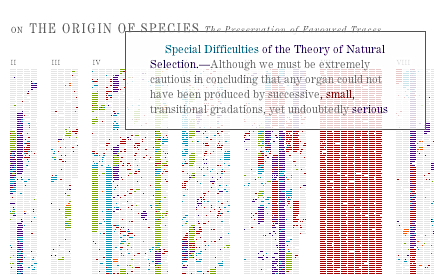
The Evolution of the Origin visualized

Origin-Evolution-visualized.jpg

My students know I never tire of emphasizing the self-corrective nature of science: how scientific theories are always dynamic theories, constantly being tested against reality, discarded if they fail the test, and continuously revised and refined as we get a better and better approximation of truth. A good example of a scientist who put his own ideas, his life's work, through this process of continual testing and refinement is of course, Charles Darwin. We all know about how he hesitated to publish his theory of evolution by natural selection for c.20 years, 15 of those after he had written out a detailed "outline", but his work didn't stop with the publication of On the Origin of Species in 1859 (we're coming up on the 150th anniversary of its publication in November this year). He continued to tinker with the book, tweaking the language, refining his arguments, and responding to criticisms as well by eventually adding a whole chapter on the subject - and publishing a total of 6 editions of the book over the next 13 years. Students taking Evolution at Fresno State have in recent years been reading the 1st edition of the classic book, chosen because we want them to experience the book as the world first encountered it, before Darwin had to worry about responding to critics. But the 6 editions themselves represent an evolution of sorts, with favored passages being preserved and refined while others were selected out. Darwin scholars have been studying the differences, and now the rest of us also have a new way to appreciate this textual evolution, through a fascinating new visualization created by Ben Fry of Seed Visualization's Phyllotaxis lab. This dynamic Flash graphic takes you through all the changes to the text much the same way a phylogeneticist might compare DNA sequence changes across a taxon's evolutionary lineage. And as you can see in the gel-like excerpt I've put at the top of this post, you can click on any "band" in any portion of the text-gel to read the mutations therein! Go check it out - its really cool! And read also Ben Fry's interview in Seed about this visualization.

Read More...

Thursday, February 5, 2009

On Darwin, Lincoln, and modern life

Struggling to fall asleep last night with this nasty cold-flu thing that has me in its grips for the past several days, I happened upon the Charlie Rose Show on PBS. I'm not a regular viewer of this show, what with Rose's penchant for giving so much air time to that airhead pundit Thomas Friedman (64 appearances!!! really need that much hot air, Charlie?!). But Rose does get some excellent guests from time to time, and provides space for a deeper conversation than the typical tv talk-show - one has to give him that! And last night was just such an occasion, for Charlie had on the New Yorker writer Adam Gopnik, discussing his latest work: "Angels and Ages: A Short Book About Darwin, Lincoln, and Modern Life", which sounds absolutely fascinating. I was pleased to discover just now that the Charlie Rose show offers entire programs online, allowing me to embed this interview below. The first half is what really gripped me, with Gopnik talking about Darwin and Lincoln — men born in a cosmic coincidence on February 12, 1809 — as embodying the twin pillars of the modern world: science and liberal democracy. So true! This is really well worth listening to when both these figures loom so large in our consciousness in this month of their bicentennial. And you Evolution students really need to pay attention when Gopnik describes Darwin's writing style! The second half is about a more recent interesting figure, the late writer John Updike. Here, watch the whole thing:


Now I've got one more "short" book to add to my reading pile - terrific!


Read More...

Tuesday, February 3, 2009

Evolution as a path to emancipation

One of the worst canards that the creationists like to throw at Darwin is that his theory led directly to the 20th centuries atrocities of Stalin, Hitler and the holocaust. The most egregious and blatant example of this was in Ben Stein's propaganda piece last year. I wonder what these people will have to say to this new perspective on what motivated Darwin to develop his theory of evolution and search for a common ancestor for all human beings, and other species:


"It makes one's blood boil," said Charles Darwin.


Not much outraged the gentle recluse, but the horrors of slavery could cost him a night's sleep.


He was thinking of the whipped house boy and the thumbscrews used by old ladies in South America, atrocities he had witnessed on the Beagle voyage.


The screams stayed with him for life, but how much did they influence his life's work?


Today you can still read of Darwin's "eureka" moment when he saw the Galapagos finches.


Alas, his conversion to evolution wasn't so simple, but it was much more interesting. It didn't occur in the Galapagos, but probably on his arrival home.


And new evidence suggests that Darwin's unique approach to evolution - relating all races and species by "common descent" - could have been fostered by his anti-slavery beliefs.

[via BBC NEWS | Darwin's twin track: 'Evolution and emancipation']

Darwin wrote with considerable feeling about his experiences among the natives of South America, as in this passage from "The Voyage of the Beagle:


"On the 19th of August we finally left the shores of Brazil. I thank God, I shall never again visit a slave-country. To this day, if I hear a distant scream, it recalls with painful vividness my feelings, when passing a house near Pernambuco, I heard the most pitiable moans, and could not but suspect that some poor slave was being tortured, yet knew that I was as powerless as a child even to remonstrate. I suspected that these moans were from a tortured slave, for I was told that this was the case in another instance. Near Rio de Janeiro I lived opposite to an old lady, who kept screws to crush the fingers of her female slaves. I have stayed in a house where a young household mulatto, daily and hourly, was reviled, beaten, and persecuted enough to break the spirit of the lowest animal. I have seen a little boy, six or seven years old, struck thrice with a horse-whip..."


As the BBC article, and the new book, traces some of the less well-known aspects of his life-story, it is worth remembering that Darwin had another, less luminary mentor: a freed slave who taught him taxidermy and likely planted the seeds of longing for the lush tropical forests of distant South America five years before he got the famous invitation to join the Beagle's voyage. During February-April 1826 young Charles spent a significant interlude with:


John Edmonstone, a freed black slave from Guyana, South America, taught Darwin taxidermy. The two of them often sat together for conversation, and John would fill Darwin's head with vivid pictures of the tropical rain forests of South America. These pleasant conversations with John may have later inspired Darwin to dream about exploring the tropics. In any event, the taxidermy skills Darwin learned from him were indispensable during his voyage aboard H.M.S. Beagle in 1831.


Another remarkable chapter from the life of a remarkable man, who was way ahead of his times. Another reason to celebrate the man... but I'm not holding my breath for the creationists to stop vilifying him, much less join the celebration.


Read More...

Monday, January 26, 2009

A graphic novel in time for the bicentennial

Now this might be something to get the kids really excited about:


Doesn't he look dashing, that young field biologist? Says Simon Gurr, the illustrator:


Less than a week now until the printers deliver Darwin: A Graphic Biography, the latest 100-page comic book from Eugene Byrne and me. I’ve seen the proofs and can’t wait to hold the book itself in my hands. The big launch is on 30th Jan, stay tuned for more details and to find out how to get hold of a copy.


And now I can't wait for this week to end...


{Hat-tip: Joe@ForbiddenPlanet]


Read More...

Monday, December 1, 2008

On the Origin of Species - revisited via the ghost of Asa Gray

As you are probably aware, especially if you are a student in my Evolution class, Charles' Darwin's seminal work "On the Origin of Species by Means of Natural Selection" has just passed a significant milestone: its 150th birthday in print! As you may also have noticed, a number of print and online publications and websites have been marking the occasion in various ways; some I have bookmarked for sharing here, but haven't gotten around to as yet!


At the beginning of the semester (as I do every semester), I had asked you students to approach the book through as fresh (even naive) a perspective as you could muster, setting aside any preconceptions and trying to put yourself in the mind of an educated person in 1859 getting your hands on the book for the first time, hot off the presses. That, of course, is easier said than done; especially when in class we are surveying the latest discoveries and insights from evolutionary biology. How can one erase 150 years of scientific progress on the question from one's memory? I'm presuming, of course, that at least some of that accumulated wealth of knowledge from these 150 years has trickled down into your consciousness through your various classes (and despite perhaps your best efforts!). Well, I hope most of you have made it at least most of the way through the wonderful (if tedious to some modern eyes) book. If so, you will appreciate this classic review, reprinted by The Atlantic Monthly where it was first published in 1860 upon the book's maiden voyage across the pond to the American market, and written by Asa Gray, the eminent botanist, contemporary and close correspondent of Darwin himself. Here's a wikipedia excerpt about the two men:

Corresponding with Charles Darwin, Gray was helpful in providing information for the development of Darwin's theory on The Origin of Species. Gray, considered by Darwin to be his friend and "best advocate", also attempted to convince Darwin in these letters that design was inherent in all forms of life, and to return to his faith. Notwithstanding, Gray was a staunch supporter of Darwin in America, and collected together a number of his own writings to produce an influential book, Darwiniana. These essays argued for a conciliation between Darwinian evolution and the tenets of orthodox Protestant Christianity, at a time when many on both sides perceived the two as mutually exclusive.

That should prime you to go read the review, which is pretty sharp and honest, starting on this cautious note:

Novelties are enticing to most people: to us they are simply annoying. We cling to a long-accepted theory, just as we cling to an old suit of clothes. A new theory, like a new pair of breeches, ("The Atlantic" still affects the older type of nether garment,) is sure to have hardfitting places; or even when no particular fault can be found with the article, it oppresses with a sense of general discomfort. New notions and new styles worry us, till we get well used to them, which is only by slow degrees.


Wherefore, in Galileo's time, we might have helped to proscribe, or to burn had he been stubborn enough to warrant cremation-even the great pioneer of inductive research; although, when we had fairly recovered our composure, and had leisurely excogitated the matter, we might have come to conclude that the new doctrine was better than the old one, after all, at least for those who had nothing to unlearn.


Such being our habitual state of mind, it may well be believed that the perusal of the new book "On the Origin of Species by Means of Natural Selection" left an uncomfortable impression, in spite of its plausible and winning ways. We were not wholly unprepared for it, as many of our contemporaries seem to have been. The scientific reading in which we indulge as a relaxation from severer studies had raised dim forebodings. Investigations about the succession of species in time, and their actual geographical distribution over the earth's surface, were leading up from all sides and in various ways to the question of their origin. Now and then we encountered a sentence, like Professor Owen's "axiom of the continuous operation of the ordained becoming of living things," which haunted us like an apparition. For, dim as our conception must needs he as to what such oracular and grandiloquent phrases might really mean, we felt confident that they presaged no good to old beliefs. Foreseeing, yet deprecating, the coming time of trouble, we still hoped, that, with some repairs and make-shifts, the old views might last out our days. Après nous le deluge. Still, not to lag behind the rest of the world, we read the book in which the new theory is promulgated. We took it up, like our neighbors, and, as was natural, in a somewhat captious frame of mind.

and towards the end, warily acknowledges the "uncanny look" as well as the "mischief" of the book:

So the Darwinian theory, once getting a foothold, marches boldly on, follows the supposed near ancestors of our present species farther and yet farther back into the dim past, and ends with an analogical inference which "makes the whole world kin." As we said at the beginning, this upshot discomposes us. Several features of the theory have an uncanny look. They may prove to be innocent: but their first aspect is suspicious, and high authorities pronounce the whole thing to be positively mischievous.

Doesn't that make this your must read essay of the week?


Read More...

Wednesday, September 17, 2008

Darwin gets a belated apology from one church?

That would be the Church of England, which yesterday posted this apology to Charles Darwin on the new Darwin 2009 section of their website:


Charles Darwin: 200 years from your birth, the Church of England owes you an apology for misunderstanding you and, by getting our first reaction wrong, encouraging others to misunderstand you still. We try to practice the old virtues of 'faith seeking understanding' and hope that makes some amends. But the struggle for your reputation is not over yet, and the problem is not just your religious opponents but those who falsely claim you in support of their own interests. Good religion needs to work constructively with good science – and I dare to suggest that the opposite may be true as well.


Maybe you're wondering: who cares what the stuffy old Church of England says? Or, what's the point of apologizing to a man dead for over a century and a quarter? Does the Archbishop of Canterbury even have much resonance with the religious public in the US, which is the real battleground in the anti-Darwin wars these days? Whatever you think of this apology - at least good old Charlie got off lightly compared to some earlier men of science caught in other church crosshairs - like, say, Galileo (who suffered during the latter parts of his life, and got his apology only recently). I guess if you believe in eternal life, you might think it is never too late to atone, so there is perhaps some logical consistency.


But wait, the essay containing the above statement, by Revd. Dr. Malcolm Brown, is not actually an official apology from the CofE, according to a spokesman, but just his personal view! So much for that, then...


Nevertheless, its worth noting that the CofE Darwin 2009 website is apparently sincere in trying to set the record straight, as seen especially in the Darwin and faith section, which uses Darwin's own words to show how he gradually lost faith despite his earlier religious training. I especially like this quote:


“Formerly I was led by feelings such as those just referred to (although I do not think that the religious sentiment was ever strongly developed in me) to the firm conviction of the existence of God, and of the immortality of the soul. In my Journal I wrote that whilst standing in the midst of the grandeur of a Brazilian forest: ‘It is not possible to give an adequate idea of the higher feelings of wonder, admiration, and devotion, which fill and elevate the mind.’ I well remember my conviction that there is more in man than the mere breath of his body. But now the grandest scenes would not cause any such convictions and feelings to rise in my mind.”


The man sure knew how to turn a phrase, didn't he?


And its good to see the church avoid sugar-coating, or quote mining to suppress that last sentence, let alone claiming some ridiculous death-bed conversion! That's something, I'd say; and its nice to have a website from such a major church to point to the next time some devout christian comes around in distress over Darwin or some religion-vs.-science conflict!


Read More...

Tuesday, July 1, 2008

Happy Natural Selection Day!

Well, there isn't one, officially, but today should be it! For 150 years ago on July 1, 1858, the world first officially heard about the theory of evolution by natural selection, in a joint presentation of papers by Alfred Russel Wallace and Charles Darwin. And this being the sesquicentennial year for the theory, let's continue celebrating for the whole year, shall we? Here's an essay on Wallace to get you going:


Darwin.jpg


Today we celebrate the 150th anniversary of the first public announcement of what Richard Dawkins has called "...the most momentous idea ever to occur to a human mind." He was of course referring to the theory of natural selection, the primary mechanism driving the evolution of life on our planet; an idea actually discovered independently by two minds, not just one. Whilst the owner of one of these brains, Charles Darwin, is rather well known, the possessor of the other, Alfred Russel Wallace, is not exactly the household name he once was. So who was Wallace and how did he come to be the co-discoverer of what is probably the most revered (and reviled) idea in human history?


[From The Beagle Project Blog: A guest post by Wallace's Rottweiler on the 150th anniversary of natural selection.]

As to Wallace's more famous co-author, 'here's a video of his rottweiler, 'Dawkins on Darwin' courtesy Channel 4. And, of course, there is more at ScienceBlogs.

And for you students in Fresno State, isn't it about time we had a cadre of Darwin's Bulldogs on campus? (For those not from around here, the official mascot for Fresno State is Bulldogs!)

Read More...

Thursday, June 26, 2008

A letter that changed the world...

3CEE119B-B963-405D-B8AE-4E243C79524B.jpeg...arrived in Darwin's post 150 years ago last week. It is remarkable to think about this kind of potent correspondence in this age of instant messaging, isn't it? Here's how the story begins:


In early 1858, on Ternate in Malaysia, a young specimen collector was tracking the island's elusive birds of paradise when he was struck by malaria. 'Every day, during the cold and succeeding hot fits, I had to lie down during which time I had nothing to do but to think over any subjects then particularly interesting me,' he later recalled.


Thoughts of money or women might have filled lesser heads. Alfred Russel Wallace was made of different stuff, however. He began thinking about disease and famine; about how they kept human populations in check; and about recent discoveries indicating that the earth's age was vast. How might these waves of death, repeated over aeons, influence the make-up of different species, he wondered?


Then the fever subsided - and inspiration struck. Fittest variations will survive longest and will eventually evolve into new species, he realised. Thus the theory of natural selection appeared, fever-like, in the mind of one of our greatest naturalists. Wallace wrote up his ideas and sent them to Charles Darwin, already a naturalist of some reputation. His paper arrived on 18 June, 1858 - 150 years ago last week - at Darwin's estate in Downe, in Kent.


Darwin, in his own words, was 'smashed'. For two decades he had been working on the same idea and now someone else might get the credit for what was later to be described, by palaeontologist Stephen Jay Gould, as 'the greatest ideological revolution in the history of science' or in the words of Richard Dawkins, 'the most important idea to occur to a human mind.' In anguish Darwin wrote to his friends, the botanist Joseph Hooker and the geologist Charles Lyell. What followed has become the stuff of scientific legend.

[From How Darwin won the evolution race | Science | The Observer]

Go read the rest to kick off the celebrations for the sesquicentennial anniversary of this momentous event in human history. And while online, check out the original essay in the letter from Wallace which set things in motion, available via the Alfred Russel Wallace Page. You can also download a pdf version of the essay as part of a volume of Wallace's writings courtesy Google. The joint paper from Darwin and Wallace presented to the Royal Society is, of course, available in its entirety, with some added commentary, via Darwin Online.


Read More...

ShareThis

Darwin's tweets

Recent ScienceBlogs Posts on Peer-reviewed Papers

Current Readers

counter

  © Blogger template Brooklyn by Ourblogtemplates.com 2008

Back to TOP