Showing posts with label ethics. Show all posts

Wednesday, June 4, 2008

Is the Central Valley of California worse than Alabama?

I go away for a conference and stay off the blog for a couple of weeks, and so much happens! I'll be catching up with some of the events over the next few posts, and also posting a number of last-minute submissions from students during the dying days of the semester, so I hope the students are still visiting this blog even though the class is over!


But let me start by noting a rather unpleasant incident that occurred on campus on the last day of the finals week: Ryan Earley, my faculty colleague who regaled us with tales of Machiavellian fish a couple of days ago, had his tires punctured for having one of those Darwin Fish stickers on the back of his car. With a crude note stuck to his windshield telling him “Fuck you Darwinist. Take your car to heaven.” Subtle response that, to a mere bumper sticker, don't you think? Not a model of behavior I should emulate or I'll be really busy with all the other stickers that abound in this town...


I'd learnt of this incident just a couple of days before I left for Germany, and so didn't get around to sharing it here. I did happen to mention it to Diwata Fonte of the Valley Notebook blog, who followed up with a blog post of her own, generating quite a few heated comments. The story got bigger (well... within the blogosphere) when PZ Myers picked up on it, and another longer discussion ensued there (as is wont to happen with the Pharyngula crowd).


Let me say that this is the first such incident I've come to know personally, although I have read of such things happening elsewhere. I have a Darwin fish on the back of my car as well, but it hasn't attracted any such ire so far. I'd also like to clear the air on one point that has come up in some of the comments on the other blogs: the absurd suggestion that Ryan may have done this to his own car to attract attention to himself or some Darwinist cause!! This is really absurd, if for no other reason than the fact that Ryan did absolutely nothing to seek attention to this incident. He simply took his car to the dealer to get fixed under warranty, told a few of us here, and shrugged it off. That the story even got into the blogosphere is actually my fault!


That said, I am still puzzled that someone would feel so aggrieved by a mere bumper sticker as to act in this way. Was it just the stress of finals week getting to some student? Or the heat wave we had seeping through here that week? Or maybe it was a valediction for Dr. Earley since he is leaving this great Central Valley of California for a faculty position in the University of Alabama this fall!


In the end, what does it say of the valley, and of our campus, if we lose promising dynamic young biologists like Ryan - to Alabama??!!


Read More...

Monday, April 28, 2008

A summary of Ted Peter's talk on the ethics of stem cell research

Student post submitted by Stephanie Chow.


Ted Peters discussed the topic of stem cell controversy at Wednesday’s ethics lecture. He brought a surprising amount of information about both sides of the debate. [I felt he was a little heavy on the pro-stem cell usage side, but he admitted that he was personally still on the fence for the issue.] A summary of what he discussed:


Regenerative medicine has the potential to offset diseases such as Parkinson’s disease, Alzheimer’s, and multiple sclerosis. This can be achieved using undifferentiated stem cells. These cells are obtained as blastocysts from fertilized eggs are broken apart. Most of the stem cells used in research come from fertility clinics. When women undergo fertility treatments, they fertilize several of their eggs at once. They use one or two at a time, and the rest are frozen. If that single treatment becomes a successful pregnancy, the woman often decides that they do not need the other eggs. Rather than be discarded, these fertilized eggs are used in research.


There are several ethical arguments against the use of stem cells. One is the embryo protection reason. Roman Catholics have taken the stance that scientists should not take apart the blastocyst to get stem cells. They feel that once an egg is fertilized (and is a zygote at that point), it has dignity because it has a soul. In other words, each unique genome correlates with a unique soul. The “14-day position” is another argument used within embryo protection. After 14 days, the fertilized egg adheres to the uterine wall and develops the primitive streak (the first stage of backbone development). Other religious groups used the 14-day position to explain their feelings towards stem cell usage.


Proponents for stem cell research contend that every fertilized egg should not automatically be considered a person. They give the statistic that 60-80% of all fertilized eggs are flushed from the woman’s body, known as fetal wastage. There is also the circumstance of chimerism, when two fertilized eggs join and a person will end up with extra genome. Stem cell advocates say that situations like these demonstrate that not every fertilized egg is a unique, soul-bearing being.


Read More...

Wednesday, April 23, 2008

A more substantial discussion about biology and theology on campus today

At least I expect it to be more substantial than the other stuff that's been going on around here lately. The last lecture of the Ethics Center's spring seminar series will be by Ted Peters, a theologian who has published extensively on the connections between science and religion and ethics.


In today's lecture "The Stem Cell Controversy: Who is Fighting Whom About What?" Peters will discuss religious and ethical issues that arise in the context of debates about stem cell research and biotechnology. This talk will be based in part on Peters’ recent book, The Stem Cell Debate.


The lecture will be at noon in the Alice Peters Auditorium at the University Business Center.


Ted Peters is Professor of Systematic Theology at Pacific Lutheran Theological Seminary and the Graduate Theological Union in Berkeley, California. His recent books include: Science, Theology, and Ethics, Playing God? Genetic Determinism and Human Freedom and the forthcoming Sacred Cells?: Why Christians Should Support Stem Cell Research. Peters also serves on the Scientific and Medical Accountability Standards Working Group for the California Institute for Regenerative Medicine (CIRM).


Andrew Fiala reminds me to add that Peters will also be meeting with students in the philosophy club from 2-3 in USU 311, where he will lead an informal and general discussion of religious studies, theology, science, free will and determinism, and whatever else students want to talk about. Faculty and students are welcome to attend.


And students, if you attend, consider submitting your impressions/reflections on the talk and the general topic of stem cell ethics for this class blog.


Read More...

Wednesday, March 19, 2008

Is stem cell therapy ok if it comes from the East?

Here's something to ponder in the wake of Jason Bush's talk, as we await the next lecture (on April 23rd) in the Ethics Center Seminar series where theologian Ted Peters (author of The Stem Cell Debate) will take up some of the more sticky moral controversies that Jason punted on last week! While a lot of the opposition to stem cell research in the US comes from the religious right, especially over the issue of embryonic stem cell research, there is opposition from the left as well - especially the "alternative medicine" left which sees everything in western medicine as being somehow tainted and unnatural. And then, by (illogical) extension, that any other "alternative" to western medicine is therefore much better for you, even if practitioners of said alternative don't have a clue about how their medicine works, if it works at all! But what if "eastern" medicine starts offering therapies based on stem cell research (and other products of "western" science)? And start doing so when such therapies are not available here in the west? Skeptico raises this question in an interesting commentary on an NPR story about how some Americans are heading to China seeking stem cell therapies not available in the US. In addition to the welcome and enjoyable bashing of irrational "skeptics" like Bill Maher, Skeptico makes this important point:


The truth is, ancient people, who did not understand how the body works or what really made people ill, just made stuff up about these things. The ancient Chinese made up stuff about meridians and chi. Ancient Indians made up stuff about chakras. Ancient Europeans made up stuff about humors. We now know better, and so have abandoned humors and bloodletting. The only mystery is why people still insist that chi and chakras are real. But whatever you believe is real, the distinction clearly is not between “western” and “eastern” (fill in your preferred country) therapies. The distinction is between therapies that work and those that don’t. Scientists in China are researching real medicine, and trying to find out what works and what doesn’t, just like scientists in the west. Maybe some have oversold their results, but scientific procedures, not ancient myth, will ultimately decide what works and what doesn’t.


So can we now please abandon this pretence that doctors in the west practice something called “western medicine”, while the Chinese have access to some secret knowledge that “western science” still hasn’t yet caught up with? There is only medicine that works – or at least, is backed by reliable evidence that it does – and pre-scientific superstitious quackery that doesn’t. The East/West labels mean nothing. And the next time some twit like Maher intones gravely against “western medicine”, just say, “yeah, I don’t fancy bloodletting either” - and advise him to go visit Doctor Hu in Hangzhou. Preferably on a one-way ticket.


I've always thought that the main criterion in medicine is whether it works. Even if we don't fully understand underlying mechanisms! Any good medicine should aim to cure the afflicted, without getting caught up in its own dogmas about how the human body is supposed to work. Figuring out the "how" and "why" of any successful medicine - well that's the job of science. That's why you can have many "alternative" medicines, but only one science - for there is no western or eastern science once we understand how any particular disease and its cure works, is there? And on the flip side (and this may raise some of your hackles), that's why medicine (even in the west) isn't always necessarily a science either!


Read More...

Wednesday, March 12, 2008

Let the Training Begin (reflections on Bush's lecture)

Stem+cell+research_670_18006666_0_0_10474_300.jpg Dr. Bush gave a fascinating lecture today on stem cell research; how far we have come and how far we have left to go. The first mouse embryonic stem cells were cultured in 1981, and the first human embryonic stem cell was cultured in 1998. Just a decade later, scientists are able to transform these and other stem cells into any tissue in the body. A technique done regularly among researchers is somatic cell nuclear transfer. This is when the nucleus is removed from an unfertilized egg cell and replaced with the nucleus from a patients somatic cell (heart cell, liver cell, etc.). This ultimately puts the genetic material of the patient into cells that can become any part of their body. This is exciting because whenever tissue is transplanted into a human being there is always the risk of rejection, but this method minimizes that risk because the cell contains instructions for life, unique to the donor.

Some might ask how the undifferentiated stem cells become destine for specific tissue types. One way scientists are doing this is by treating stem cells with different “cocktails” of growth factors that will determine their final destination. One example Dr. Bush gave was the experiment where mouse cells were treated with two different growth factors which caused them to become cardiac muscle cells. He showed a brief video of these cells and they were actually beating! He said they are now even able to take cells that are already at there terminal state, like skin cells, and make them into stem cells. We saw an example of this in class when Dr. Katti showed us how they took skin cells, turned them into stem cells, which became red blood cells that were placed in a mouse with sickle cell anemia and ultimately cured the mouse of this disease.

It is truly amazing what these cells and this research is capable of. There are some set backs for those doing stem cell research. For example, the federal government will only provide funding for research done on 21 cell lines that have been approved. However, this does not stop private funding from taking place. Dr. Bush believes that we are about five to ten years away from seeing stem cells used in medicine. In July of this summer, Dr. Bush is going to have a workshop for university professors showing them how to culture stem cells so that, in the future, college courses can be designed to teach students these methods.

From the stand point of evolution, will stem cells and their potential in medicine ultimately have adverse effects on the human population? Futuristically speaking, if we eliminate disease are we eliminating natural selection on our species? Will this cause the human population to rapidly overshoot its carrying capacity because everyone is living healthy lives without terminal illnesses? Or on the other hand, will new diseases arise from strains of mutant stem cells? As much as it is exciting to find cures to Parkinson’s, liver disease, and sickle cell anemia; it is equally frightening to ponder the repercussions of this new wisdom.

Check out these websites for additional news regarding stem cells:


Somatic Cell Nuclear Transfer (Therapeutic Cloning)

California Institute for Regenerative Medicine

Chemical Turns Stem Cells Into Beating Heart Cells


[contributed by Sheena Edmonds]

Read More...

Tuesday, March 11, 2008

Bush to speak on the ethics of stem cell culture - Mar 12 noon @ Fresno State


No... not that Bush / Shrub! Rather, its our own department's Jason Bush, who actually knows a little something about stem cell research as a scientist, and who happens to be from north of the border - the northern border of the US, that is. Our Bush will be speaking as part of the CSU-Fresno Center For Ethics spring lecture series:

March 12
Jason A. Bush: “The Art, Mystery, and Controversy of Stem Cell Culture”
As stem cell research has exploded in the past 5 years, fundamental concepts have changed and we have made technical advancements. Scientists see the potential and opponents see the slippery slope. This lecture will discuss the complex issues that engulf stem cell research.
Jason Bush has a Ph.D. in Experimental Medicine from the University of British Columbia. He did post-doc work in Cancer Biology at The Burnham Institute. He is Assistant Professor in the Biology Department at Fresno State.
[From Upcoming Ethics Center Events and Lectures]
The lecture will be in the Alice Peters Auditorium at 12:00 PM on March 12, 2008. Should be fun, so try to be there!

Read More...

Monday, February 25, 2008

Reprogramming our cells to fix those darn mutations

Yes, we seem to be approaching that brave new world where we can fix mutations in our genomes to treat certain genetic diseases. The technology has already reached the point where it can handle at least point mutations as seen in this astonishing piece of recent research where they were able to reprogram cells in mice to treat sickle-cell anemia. You can find a nice description of the work with some background to put it into context in this essay on "Not Exactly Rocket Science", a blog I discovered while updating the bit about sickle cell in my lecture on mutations for today's class. It looks like a blog well worth reading on a regular basis, and has a number of other good examples of commentary on peer-reviewed articles you might emulate for your blogging for this class!

And as you absorb this paper, and marvel at how we might, someday soon, be able to fix some of our genetic defects, ponder the ethical implications of acquiring this ability to tinker with our genes at this level!

Read More...

Wednesday, February 6, 2008

What is this I'm eating?

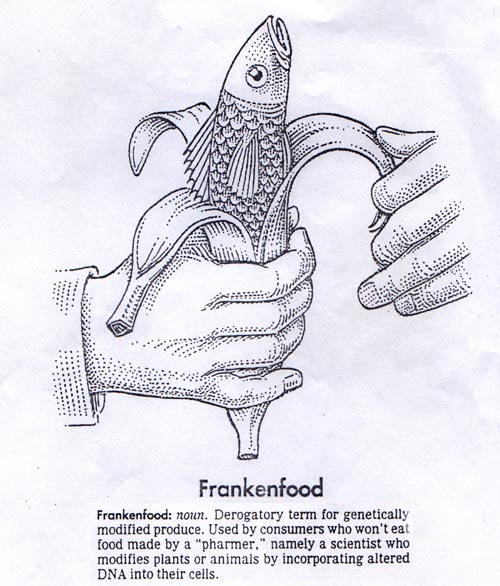
frankenfood_large.jpg

If you ever pause to wonder about what exactly is in the (likely highly processed) sandwich you are eating for lunch, and if whatever's in there is really good for you, you might want to swing by this noon to listen to my colleague Jim Prince's take as part of the Ethics Center's Spring Lecture series:

Jim Prince: “What is this I'm eating?”

Biologist Jim Prince will lead a discussion of the science and ethics of genetically modified food. What are the risks? What are the benefits? Can we afford to tinker with our food sources? Can we afford not to?

Jim Prince is Professor of Molecular Genetics at Fresno State. He received his Ph.D. in plant molecular biology from Cornell University. He did postdoctoral work at the USDA and Cornell University.
The class agreed to attend this talk rather than listen to me drone on in another lecture (the seminar being in the same time-slot as our Evolution class), so I expect a strong showing from the BioSc 180 students! Meanwhile, here's a few more thoughts to chew on.

Molecular biology, genetics, and biotech seem to be particularly good, among all technologies, in raising our hackles about opening Pandora's box, perhaps because they have the potential to hit us directly in our bodies - where it hurts! And perhaps as a result, breakthroughs and developments in this area seem to always stir up shrill rhetoric from both sides: those who tout the technology as almost magical solutions to world hunger and disease, and those who would raise the specter of Frankenfoods to scare the pants off of us. Take the recent green light given by the FDA for food produced from cloned animals. James McWilliams argues, as you may have seen on the Op-Ed page of the NY Times yesterday, for a more moderate, rational middle ground exploring this frontier of the precautionary principle, and I agree with his perspective. A friend of mine wrote last week to ask me what I thought about the FDA decision, and my immediate email response was that it was hard to imagine serious health issues for humans from cloned meat or other animal products. After all, we've been eating cloned plants for centuries without anyone worrying too much about it. Why do we draw a different line when it comes to cloned animals?

What do you think?

dbrn319l.jpg

Read More...

ShareThis

Darwin's tweets

Recent ScienceBlogs Posts on Peer-reviewed Papers

Current Readers

counter

  © Blogger template Brooklyn by Ourblogtemplates.com 2008

Back to TOP