Showing posts with label life. Show all posts

Friday, May 21, 2010

Synthetic life is here? Deal with it.


via ted.com

That was the big story of the week in biology: the creation, in the lab, of a synthetic organism - a radically transgenic (transgenomic?) bacterium that had all its DNA replaced by a chromosome sequenced on a computer! So - not entirely synthetic, but enough where it counts, in its DNA. With a website url embedded within its code, no less! Heck, for all I know, the code for the above video might be embedded in there too! Or, at least, Dr. Venter's own face.

I know this has caused much stir in the media and for a number of people who were apparently not expecting anything like this to happen so soon (and Venter's hubris sure helps fan the flames as you can see in the comments thread responding to the TED video). Well, I think that most people familiar with modern molecular biology knew this was coming. Too soon? I don't know. Hardly surprising though, especially given Venter's record and stated ambitions in this area. I don't know enough about the molecular biology involved to say whether this is as big a breakthrough as is being suggested, but the feat sure seems pretty impressive.

As for what it means - I'll let the moralists on various sides (from the POTUS on down to your corner church and/or eco-anarchist co-op) sort that one out! We know (and have known for some time) that the technology is here, more or less, and now we have this semi-synthetic creature in our midst. Life just gets more exciting, doesn't it?

Venter was also interviewed on Science Friday earlier today, about this work. They don't have the audio up on the archive page for the interview yet, but I suspect they will soon enough, so keep an ear there if you want to hear more about this. And, for the gory details, you probably want to read the actual Science paper as well, right?

Read More...

Sunday, September 6, 2009

Why I am a scientist

Not that I want to make this blog much more autobiographical or self-indulgent (what the hell, its my blog!), but a recent thread on twitter and in the blogosphere, started by Andrew Maynard at 2020Science, with a follow-up by Steven Hill at Testing hypotheses... about how they were inspired to become scientists, has got me reminiscing again about my own sources of inspiration that led to this life in science. I also think my story might be worth sharing because of a background that is rather different from the others mentioned above - so allow me to offer a different view from another part of the world. Here, without further ado, is my list (in not strictly chronological order) of significant influences on the road to becoming a scientist:


  1. Mrs. Menon: my science teacher from ~5th grade on in New English High School in Ulhasnagar, a distant suburb of Bombay. She had a reputation as one of the best teachers in school, and I was really looking forward to being in her science labs. But scientific enlightenment came in a rather opposite way than I (and perhaps she) might have anticipated: not by example of what she knew and taught us, but by the realization during one class that she didn't know (or was confused about?) something quite basic! I remember vividly: she was lecturing us about how "water seeks its own level" with the example of a U-tube filled with water where if you raise one "arm" of the tube, water will appear to rise up that arm and fall down the other arm. Wait... what?! Shouldn't water fall in the arm being raised and rise in the other one to maintain its level? That was what I shot up my arm to ask her and we had a bit of an argument, with the rest of the class on the sidelines. I asked why we don't do the experiment and see what happens - surprisingly, she agreed, and pulled out a rubber u-tube. Of course, the experiment proved me right - and we went on with the rest of the lesson. Why has this incident (almost more than anything else I learned in the 12 years in that school) stayed with me so vividly? Because it shattered my illusion, nurtured in the traditional hierarchical culture of deference to elders and authority still prevalent in India, that these elders/authorities actually knew what they were talking about! They could be so wrong! And little old me could show them how they were wrong - empirically. What an empowering moment for a 10-year old!! In retrospect, it was remarkable the Mrs. Menon even allowed me to challenge her in class and let me conduct an experiment that proved her wrong in front of the whole class. And I still don't know to this day whether she went through the whole thing as a teaching device, to make us think, or if she had simply made a mistake and was sticking to her guns in the heat of the classroom moment when confronted by a student actually paying attention to what she was saying. My ego (and the fact that this was a unique event in all the years in her class) would like to think it was the latter, but as a teacher myself now I wonder if she was wilier than she let on? Either way, thank you Mrs. Menon, wherever you are, for setting me on the path to a life in science!


  2. Charles Darwin. Of course, my students might say, rolling their eyes - but that's not a cliched answer! It was not reading anything Darwin wrote that got me into biology, but the story of his life as novelized by Irving Stone in The Origin which I picked up during college from a second-hand book-stall on the sidewalks of Flora Fountain in Bombay. (And thank you Dad, for alerting me to Stone's work in the first place by recommending his Lust for Life).


  3. Stephen Jay Gould's The Panda's Thumb and other writings. I've gushed a bit about Gould in the recent past so I won't say more.


  4. Libraries! A decent well-stocked public library is practically nonexistent in Indian towns, sadly. But Bombay offered alternatives, and me and my buddies, like so many others of our college generation, made the most of them, spending a lot of time in the very different libraries of the British Council (Darwin, Patrick Moore, Attenborough, Dawkins, and, of course, PGW), American Center (Gould, Sagan, Steinbeck, Asimov, Carson), and Soviet (yes - this was pre-perestroika! Engels, Tolstoy, Mayakovsky). These libraries opened up a whole world of science and wider literature that was largely unknown even to most of my college teachers (sad, but true).


  5. Bombay's infamous local trains! If not for my daily commute from Ulhasnagar to Bombay VT (75-105 min each way depending upon whether I caught the fast or slow local), I never would have had the time to read all those wonderful books, nor ponder the mysteries of the universe!


  6. The Institute of Science, a wonderful place not so much for my professors, but for its amazing library with a century-old collection of books and, more importantly, journals, actual science journals that we could blow the dust off of and marvel at (even if many subscriptions were no longer current). Here I was able to read not just about the discovery of DNA's double-helix structure, but the original Watson & Crick paper too!! The labs were pretty well equipped also with some real research ongoing - this is unusual again in the Indian context, where for most undergrads "science" is stuff you memorize from out-of-date textbooks and hand-me-down notes, rote dissections and lab "experiments" - not something you can, you know, get your hands dirty actually doing!! But this Institute (which, sadly, has walled itself off from undergraduate teaching once again) allowed a bunch of us ne'er-do-well undergrads to run around the labs tinkering with things, building telescopes, and generally having a ball learning to do science on our own.


  7. Peers. And this is another one I want any students reading this to remember - your peers are perhaps the most important component of your learning, especially in science, so surround yourselves with curious, nerdy friends! Although I didn't have any truly inspirational (in the positive sense) science teachers until I reached graduate school, I was lucky enough to find a bunch of fellow-traveler-nerds with whom I shared a natural curiosity about the world and a growing love for science as a way to satisfy that curiosity. Vishy, Pradeep, Rajesh, Ravi, et al (and my sister Vaijoo) - if not for them, I might well have ended up a bank clerk or worse!


  8. Finally, like Maynard, I must also tip my hat to all my school and undergrad science teachers who did their best to beat the curiosity and wide-eyed wonder out of me, to make science dull and tedious, to make me respect authority, to do well on standardized tests, and so help me get into medical school (my parents' ambition which I so utterly failed to fulfill)! And a special bow to the Head of the Biology Department at Ruia College (sorry I can't remember his name, this was in 1987) for taking a half hour of his valuable time trying to talk me out of joining the strange new MSc Wildlife program at the Wildlife Institute of India, to keep me from throwing a promising career away!! Thus, for my ability to withstand all that counter-programming, and persisting in this doomed business of science, I have to give another shout out to Mrs. Menon: thanks again, Ma'am!!


A final note for those of you who've known me since graduate school days and may wonder why I haven't mentioned any influences past 1987: its simple - I was already on the path to becoming a scientist by the time I got to WII. This list is of the signposts that helped me find that path in the first place!


Now, dear reader, how about sharing your own story? How did you become a scientist?

Read More...

Tuesday, April 7, 2009

When fishes started to walk on land and breath air

As an impressionable youth, I first saw "Life on Earth" in 1983 during my first year as an undergrad at the Institute of Science in Bombay,, pursuing a degree in zoology. And did it ever leave an impression on my mind! Of course, this was back in the days before video players, let alone DVDs. And we didn't yet have a television at home - nor do I remember the show actually being telecast in India anyway. So how did I see it? I was actually lucky enough to get to watch it projected on a big screen, with a 16mm projector whirring away quietly at the back of the big classroom. Someone at the Institute had borrowed the films for the entire series from the wonderful British Council Library! Of course, that same library which (along with the American and the Soviet ones) had already helped change the course of my life away from medical school towards zoology! Thank you Messrs. Darwin, Gould, Commoner, PGW, Steinbeck, Tolstoy... and David Attenborough. Ahh... the formative memories from those formative years. Nostalgia aside, I find it astonishing that 3 decades on, when we know so much more about the evolution of life on earth, when video technology has advanced so much, and when we have 24/7 cable channels dedicated to coverage of the living world, we still haven't seen but the one, and only, David Attenborough! Enjoy:


Read More...

Monday, March 16, 2009

Why are all earthly lifeforms lefties?

ResearchBlogging.orgWhat, you think you are not left-handed? Just because you favor your right hand to write/eat/pitch that baseball, etc.? Actually, in case you didn't already know this: deep down, at the amino acid level, we are all lefties! Southpaws, each and every one of us! That's just another one of those wonderfully weird arbitrary fact about life on earth! Amino acids, the building blocks of proteins, are fundamental to the structure and function of life as we know it on our planet (which is pretty much how we know life at all, because we haven't found any other kind - yet!) - and the atoms making up each molecule can be put together in different ways to produce configurations which are mirror-images of each other (chirality, as the chemists call it); we know this because we can make amino acids in the lab. Yet, all life-forms we know of only contain one version of the amino acids - the left-handed one from the mirror-image pair! So this is another deep molecular homology involving amino acids (like the language of the genetic code we discuss in Evolution class), which unites all life-forms on this planet with a shared common ancestor. But there is no inherent reason why that ancestor had to be a southpaw in its use of amino acids. Was it just a random accident that that is how we turned out? A new study of the famous Murchison meteorite takes on the question...


Did lefty molecules seed life? (as reported in The Scientist today): "Amino acids come in left-handed and right-handed forms, which, like a pair of human hands, are mirror images that cannot be superimposed onto each other. Yet living organisms use only the left-handed version, which presents a conundrum: There's no biochemical reason why one mirror image should be better than the other, so scientists have long debated whether life's left-handed leaning arose because of random processes or whether rocks from outer space seeded a southpaw solar system."


...and suggests an explanation: that there was a left-bias in the amino acids that rained onto early earth from our solar system!


The current study argues for the latter possibility by showing that some extraterrestrial meteorites contain an abundance of left-handed molecules. "The implications are that all life in our solar system could be the same handedness as life on Earth," Jeffrey Bada, a geochemist at the Scripps Institution of Oceanography in La Jolla, Calif., who was not involved in the research, told The Scientist.


Daniel Glavin and Jason Dworkin, astrobiologists at NASA's Goddard Space Flight Center in Greenbelt, MD, compared the ratio of left- and right-handed 5-carbon amino acids found in six primitive, carbon-rich meteorites that have an elemental composition similar to that presumably found in the early solar system. Three of these rocks were heavily left-skewed, while the remaining three showed equal handedness, or chirality, the researchers found. Of the lefty rocks, the meteorite that fell on Murchison, Australia, in 1969 -- arguably the most widely studied carbonaceous meteorite in the world -- contained the largest imbalance ever observed: a 18.5% excess of the left-handed form of the amino acid isovaline.


Or, in their own words from the abstract of the PNAS paper:


The large asymmetry in isovaline and other α-dialkyl amino acids found in altered CI and CM meteorites suggests that amino acids delivered by asteroids, comets, and their fragments would have biased the Earth's prebiotic organic inventory with left-handed molecules before the origin of life.


Amino acids found in these and other meteorites landing on earth tend to exhibit a bias favoring left chirality, suggesting our entire solar system has the same left-bias, setting life as we know it on its lefty path. And Glavin & Dworkin think they know what favored left chirality in the meteorites:


The mechanism that Glavin and Dworkin propose to explain the observed left-handed excess is that polarized light -- which is twisted and can rotate molecules -- probably set the imbalance in motion. Then, once the balance was slightly askew, water within the meteorites further drove an enrichment of left-handed amino acids in the liquid phase and relegated right-handed molecules to the solid phase. "The whole amplification is due to this process of aqueous alteration," said Dworkin.


Not everyone is convinced, yet, but the search for answers to these puzzles about life's origin continues. (Or we could simply say goddidit, and stop asking any further questions, couldn't we? but where's the fun in that?)


Reference:


Glavin, D. P., & Dworkin, J. P. (2009). Enrichment of the amino acid l-isovaline by aqueous alteration on CI and CM meteorite parent bodies Proceedings of the National Academy of Sciences DOI: 10.1073/pnas.0811618106

Read More...

Sunday, October 26, 2008

On the early evolution of cells

ResearchBlogging.orgSubmitted by Brandon Williams for the Evolution class.


In this article, Carl Woese provides a theory on the early evolution of cells. Woese posits that it is necessary to go beyond classic Darwinian thinking of Vertical Gene Transfer (parent to offspring). He believes that Horizontal Gene Transfer (HGT) played a more crucial role in the early development of cells; that is until each of the three branches of life (Bacteria, Archaea and Eucarya) reached their Darwinian Thresholds. This threshold is a point where the cells of random RNA and proteins have finally reached a level of complexity that they have become a “species” and Vertical Gene Transfer can take over. Before that, cells traded genetic material with each other, evolving as a community.


I commend Woese for attempting to push us past the thought of endosymbiosis. While endosymbiosis may have occurred, the two cells that combined had to have been fully evolved cells that functioned without each other before the joining. Careful consideration to his theory needs to be taken to understand how much of translation and transcription was evolved before bacteria, archaea, and eukaryotes emerged. The wide spread similarities and differences point to some truth in this.


Woese may have a better explanation than endosymbiosis as to how archaea, bacteria and eukaryotes evolved past their Darwinian threshold through HGT; however, he still cannot explain how those cells could initially evolve the genomes (albeit small) to trade parts with in the first place. He posits that translation existed before transcription or genome replication. RNA dominated and proteins were made, transcription completed evolution after each Darwinian threshold, and genome replication came third. I find it interesting yet hard to believe that nucleotides formed by themselves, without a metabolic pathway already in place, and in enough numbers to form RNAs capable of translating proteins. Enough amino acids would have to exist also and Woese gives no explanation for their appearance or the fact that they are conveniently in close proximity to the RNAs. I also find it hard to believe that such an incredible amount of nucleotides and amino acids existed to support enough primitive cells containing RNA and protein that were able to trade with each other, and that these ancient cells would survive long enough to reach a Darwinian threshold.


In conclusion, Carl Woese’s theory could have serious implications on our idea of the early evolution of cells when before we were content to recite “endosymbiosis” and leave it at that. However it still leaves us glaring at what we don’t know and may never know.


Reference:


C. R. Woese (2002). On the evolution of cells Proceedings of the National Academy of Sciences, 99 (13), 8742-8747 DOI: 10.1073/pnas.132266999


Read More...

Friday, September 12, 2008

Of unlikely black holes and the excitement of particle physics

I'm sure you've seen all the media hype lately over the switching on of the Large Hadron Collider in Geneva earlier this week. And you might also be tired of all the "end of the world" jokes over the teeny-tiny possibility that the particle physicists having all that fun with their $8-billion sub-atomic racetrack might accidently create a black hole that would swallow the earth. Well, the machine is on, no black holes yet, and the media will likely move on, shrugging its shoulders that the world is still here, almost as if they might have preferred reporting from the event horizon of a black hole; what a scoop that would be! But let's not let this teaching moment go to waste, shall we? Let's all learn some more actual physics while the topic is still hot. So, if you are still curious about the true significance of the collider and why all these physics nerds are so excited about it, you should read Brian Greene's op-ed piece in today's NYT: The Origins of the Universe - A Crash Course. And if that crash course whet's your appetite, read Sean Carroll's answer to "What will the LHC find?" where he even gives us the likelihoods of various outcomes, including the detection of the Higgs Boson (95%), Dark Matter (15%), Warped Extra Dimensions (10%), Black Holes - tiny, unstable, transient ones (1%), stable Black Holes that could swallow the earth, along with its worried crackpots (10-25%; yes, that means 0.0000000000000000000000001%), God (10-20%; indeed, more likely than the stable black hole, but not likely enough to make me go to the temple to place Pascal's wager), and a whole list of other possible known and unknown additions to the sub-atomic menagerie. Sean was also live-blogging the momentous switching on of the LHC, and you might want to bookmark Cosmic Variance if you want to keep up once the physicists actually start hurling those protons at each other in a few days (so far they've only been racing the protons all together in one direction, making sure everything is working!). If all that is a bit too much, the visual stylings of PHD comics ought to give you some relief.


Now, that should put you in the mood for the joint Biology-Physics Colloquium this afternoon at 3:00 where Fred Ringwald will talk about "Life Beyond Earth"! So if you are in Fresno, come on by, and maybe we can talk some more about all this afterwards... perhaps even over a drink!


Read More...

Sunday, September 7, 2008

Life, The Universe, and Everything Else...

ResearchBlogging.orgJennie Talbot shares her musings following the class discussion last week in Biogeography (Biol 275).

In class we discussed the idea that niches are places that supply a particular organism with all of the resources required for it to thrive. The discussion led to questions regarding how much the niche impacted the species and, in turn, how much the species impacted the niche. For example, a plant species may thrive on the side of a mountain because it is here that the plant can find soil with good nutrients, adequate sun light, and reasonable temperatures. However, as more and more plants colonize the side of the mountain, transpiration will occur at a higher rate, which will produce more moisture in the air and, ultimately cause more rain to fall. The plant’s root system will hold the nutrient-rich soil despite all of the rain. Animals may come and feed on the well-nourished plants and, in turn defecate onto the soil, adding more nutrients for the plants to use. As more and more plants grow in this favorable environment, it is likely that the side of the mountain will get more rain then it did before the plants migrated to this location. Likewise, the side of the mountain may have better soil because of the wildlife that eat the plants. In fact, the wildlife may migrate to this newly colonized region on the mountainside because of the resources available. Therefore, the cycle will continue with more rain, better soil nutrients, healthier plants, and new wildlife. In this way, the side of the mountain, which may at one point have been completely void of life, has become a bustling habitat for multiple species.


So then I have to ask the question, “Was earth created for life or did life mold the earth into what it is today?” Of course, people may say, “Yes, the earth was created for life.” Well, Harold C. Urey submits that the earliest atmosphere of earth was composed mostly of hydrogen, methane, and nitrogen with only trace amounts of other elements such as carbon and oxygen. Over time a bunch of chemical reactions occurred (if you want to know all of the reactions, read Urey’s paper) and the earth’s atmosphere changed from being predominantly hydrogen and methane based to being highly oxidized with a lot of free energy created from oxidation reactions. The available free energy made it possible for a few primitive organisms to thrive. From here on out, those small organisms began to colonize earth. Current literature suggests that heterotrophic cells evolved 3.5 billion years ago followed by autotrophic cells (somewhere around 2.7 billion years ago), eukaryotes (2 billion years ago) and then multicellular organisms (Kardong, 2005). Because of the newly formed organisms on the planet, compounds that the earth had not seen yet (like isotopes of sulfur) were made and the compounds that were available already could be molded into something that could be used by another organism (Urey, 1952; Kasting, 1993).


So what does all of that mean? It seems to me that when the earth was created, it was completely uninhabitable. Which may mean the earth was not created for life and it is because of life, that the earth is habitable now. When the earth first came to be, there were atmospheric elements that began to interact with one another. From this energy was released, organic molecules were formed and the genesis of life began. At this point in the story, organisms have done nothing to alter the earth. However, with the birth of the first autotrophic cells (and the use of photosynthesis), living organisms began to transform the earth into something that could sustain life. Since then life has molded the planet into what it is today. Of course, it is likely that life has not molded the entire planet (as in, I am not sure that living organisms have any impact on the core of the planet itself…but this is science, so you never know, something could be discovered ☺) and who knows about our impact on the entire solar system. Nevertheless, in terms of niches within our range of exploration on the surface of the earth, it seems that living organisms can have a drastic, sometimes detrimental, impact on their habitats. Image what the world would look like if there was no deforestation or animal poaching. Imagine if the mosquitoes that bite us incessantly were not provided with stagnant water supplies in the rims of old tires and so could not reproduce in new habitats and spread deadly diseases to the inhabitants of those places. What if plumes of dinoflagellates did not blanket the ocean and poison thousands of fish each year. What if asparagus seeds did not float on water? What if fungus did not decompose leaf litter on the forest floor? What would the world look like without millions of species changing the world into a place called home?


Okay, so the end of that paragraph was a little cheesy. But truly, without life shaping the planet what would the planet look like? From these thoughts, I believe, at least for now, that living organisms have morphed the earth into what we know today. Without life on this planet, the earth would look completely different.

Sources


Kardong, Kenneth V. 2007. An Introduction to Biological Evolution. 2nd ed. Boston: McGraw-Hill Companies, Inc., 49-54.


J. Kasting (1993). Earth's early atmosphere Science, 259 (5097), 920-926 DOI: 10.1126/science.11536547


Harold C. Urey (1952). On the Early Chemical History of the Earth and the Origin of Life Proceedings of the National Academy of Sciences, 38 (4), 351-363


Read More...

Thursday, April 10, 2008

And now, a frog with no lungs!

080407-lungless-frog-02.jpg

Such a biological wonder has indeed now been discovered lurking in the rainforests of Borneo, as you may have read in the science blogosphere and even mainstream news channels already!


Ain't evolution cool! Its never about "progress" in a certain direction, or increasing complexity, or any other "upward" trajectory we may think of. Its always about what works best for a given organism in its particular environmental circumstance: if a trait (such as lungs or skin to breathe through) works well enough to let you survive and make lots of babies, it may prevail and become the norm in your lineage; OTOH, if an existing trait (such as your newly evolved lungs) get in the way of surviving and procreating, natural selection might well get rid of it! Sometimes, your entire lineage goes with the trait - natural selection isn't really all that particular in that way. But if, like this frog, you have one troublesome big trait that is chafing against the filter of selection, and also have a backup system to perform the same physiological function, you may get away with losing the big new innovation!


These frogs apparently live in fast, cold, mountain streams rich enough in oxygen that they can get enough through their skins. Of course all amphibians can breathe through their skin to some extent, but the big innovation that allowed them to plant the tetrapod flag in the terrestrial realm in the first place, was of course lungs! Yet these little guys have given up on lungs, and, unable to re-invent more ancestral gills, reverted to the skin - and it'll be fascinating now to study how that skin has evolved in this species.


Meanwhile, the serendipitous discovery of this wonder must give pause to my friends who are against vivisection (for many good reasons, and some poor ones), and even against collecting specimens at all for museum collections or scientific study. And it becomes harder to argue with activists of that persuasion when it comes to rare new species. Yet, this amazing discovery would not have been possible if someone hadn't thought to look inside the body of the frog! Contrary to what the romantic Wordsworth wrote, I have to contend that we biologists do not always "murder to dissect"!


Read More...

Friday, March 21, 2008

Friday photo: ponder the evolutionary ecology of this job...

web.jpg


Seems somehow apropos towards the end of spring break week, no?


(Click on image for larger version - captured at McKenzie Preserve; © Madhusudan Katti, 2007)


Read More...

Wednesday, March 12, 2008

Let the Training Begin (reflections on Bush's lecture)

Stem+cell+research_670_18006666_0_0_10474_300.jpg Dr. Bush gave a fascinating lecture today on stem cell research; how far we have come and how far we have left to go. The first mouse embryonic stem cells were cultured in 1981, and the first human embryonic stem cell was cultured in 1998. Just a decade later, scientists are able to transform these and other stem cells into any tissue in the body. A technique done regularly among researchers is somatic cell nuclear transfer. This is when the nucleus is removed from an unfertilized egg cell and replaced with the nucleus from a patients somatic cell (heart cell, liver cell, etc.). This ultimately puts the genetic material of the patient into cells that can become any part of their body. This is exciting because whenever tissue is transplanted into a human being there is always the risk of rejection, but this method minimizes that risk because the cell contains instructions for life, unique to the donor.

Some might ask how the undifferentiated stem cells become destine for specific tissue types. One way scientists are doing this is by treating stem cells with different “cocktails” of growth factors that will determine their final destination. One example Dr. Bush gave was the experiment where mouse cells were treated with two different growth factors which caused them to become cardiac muscle cells. He showed a brief video of these cells and they were actually beating! He said they are now even able to take cells that are already at there terminal state, like skin cells, and make them into stem cells. We saw an example of this in class when Dr. Katti showed us how they took skin cells, turned them into stem cells, which became red blood cells that were placed in a mouse with sickle cell anemia and ultimately cured the mouse of this disease.

It is truly amazing what these cells and this research is capable of. There are some set backs for those doing stem cell research. For example, the federal government will only provide funding for research done on 21 cell lines that have been approved. However, this does not stop private funding from taking place. Dr. Bush believes that we are about five to ten years away from seeing stem cells used in medicine. In July of this summer, Dr. Bush is going to have a workshop for university professors showing them how to culture stem cells so that, in the future, college courses can be designed to teach students these methods.

From the stand point of evolution, will stem cells and their potential in medicine ultimately have adverse effects on the human population? Futuristically speaking, if we eliminate disease are we eliminating natural selection on our species? Will this cause the human population to rapidly overshoot its carrying capacity because everyone is living healthy lives without terminal illnesses? Or on the other hand, will new diseases arise from strains of mutant stem cells? As much as it is exciting to find cures to Parkinson’s, liver disease, and sickle cell anemia; it is equally frightening to ponder the repercussions of this new wisdom.

Check out these websites for additional news regarding stem cells:


Somatic Cell Nuclear Transfer (Therapeutic Cloning)

California Institute for Regenerative Medicine

Chemical Turns Stem Cells Into Beating Heart Cells


[contributed by Sheena Edmonds]

Read More...

Wednesday, February 27, 2008

Please Talk to Kids About AIDS? Really?

Not sure if my second-grader is quite ready for this kind of talk yet, although being raised by a couple of biologists, she may know more than her average classmate. But this film is intriguing, and worthwhile if it gets more people learning about AIDS, I suppose. So go watch: Please Talk to Kids About AIDS - Free Streaming Movie.

Read More...

Tuesday, February 12, 2008

Happy Birthday, dear Charlie Darwin!

HappyBirthday-Darwin.jpg


Aren't you glad that our campus is finally joining in the global celebrations of Darwin Day?

I recommend starting your morning off with some excellent reading material, and audio-visuals as well, courtesy the Guardian's special pullout section celebrating Darwin. Of course, those of us on the wrong side of the pond can't really pull-out that special section, but we can partake in much multi-media goodness on their excellent website. Any chance our local rag might at least mention Darwin today, you think? (unlikely - I couldn't find anything on their website) And who better to get you going than Darwin's rottweiler, Richard Dawkins, who writes:

Charles Darwin had a big idea, arguably the most powerful idea ever. And like all the best ideas it is beguilingly simple. In fact, it is so staggeringly elementary, so blindingly obvious that although others before him tinkered nearby, nobody thought to look for it in the right place.

Darwin had plenty of other good ideas - for example his ingenious and largely correct theory of how coral reefs form - but it is his big idea of natural selection, published in On the Origin of Species, that gave biology its guiding principle, a governing law that helps the rest make sense. Understanding its cold, beautiful logic is a must.
Go read the rest of it at the Guardian or on Dawkins' own site.

I trust you will later be taking a stroll on campus to check out our interactive christo-esque project to spark a conversation about Darwin and Evolution:
There will be a Christo-esque display of major ideas about evolution, both pro and con, hanging from a line that will run from the Satellite College Union to Joyal Administration. Paper will be provided so you can add your comments to the display. Come see the display and participate by adding your ideas.

And to round off the day, come learn about how parts of our own bodies are evolving:

Professor Fred Schreiber of the Department of Biology will present a public lecture and discussion titled

“NATURAL SELECTION: EVOLUTION IN ACTION IN HUMAN STRUCTURE AND FUNCTION”

5:00 – 7:00 P.M., TUESDAY 12TH FEBRUARY, ROOM 109, SCIENCE 2.

Dr. Schreiber will cover topics as diverse as skin color, the epiglottis, varicose veins, malaria and lactose intolerance. All are welcome.

“Darwin’s theory provides the theoretical and conceptual foundation for all of the biological sciences, and remains one of the most momentous intellectual developments in human history. The Department of Biology is committed to accurately representing Darwin’s ideas, and takes great pleasure in this opportunity to emphasize his seminal contribution to science and society.”

So let's remember Charlie, in his own words:
Ignorance more frequently begets confidence than does knowledge: it is those who know little, not those who know much, who so positively assert that this or that problem will never be solved by science.

- Charles R. Darwin

Happy Darwin Day everyone!

Read More...

Monday, September 10, 2007

And you thought your last flight was looong!


Check out this annual commute, suffered by that long-distance migrating champion, the Bar Tailed Godwit (Limosa lapponica). As reported on the Asia-Pacific Shorebird Network, one of these Godwits has just been observed making a non-stop flight of 11,570 Km from Alaska to New Zealand. The female known only as E7 (the name is Godwit; Bar-tailed Godwit... etc.) flew for 8 days and 12 hours clear across the Pacific (not even stopping at Hawaii or Fiji en route!) before arriving, on September 7, close to where it was tagged last February at Piako in New Zealand. This is one of the coolest results of new satellite tracking technology that is allowing such extreme flights to be monitored. You can even watch the whole flight path on your computer if you have Google Earth - just download the kmz file for an interactive version of the image below.


The kmz file has data from all birds followed in this project, allowing you to trace movements of individual birds, and isolate ones of interest, as I did above. You will also be able to follow future movements (e.g., see how and when the other birds make it down to NZ) as long as the transmitters are active, and someone is updating the database online.

Until now, the evidence that these birds actually flew back across the Pacific non-stop was indirect and circumstantial (Gill et al 2005). As described in that paper, it took much greater detective work to follow the trails of these birds, piecing together information on when and where different kinds of godwits had been seen, comparing occurrences in spring vs. autumn, and using flight simulation models to estimate if they could do such long-distance flights. And their conclusion was that the birds hewed closer to shore during spring (northern hemisphere spring), stopping to refuel at various depots along the way, but took a direct route across the Pacific in autumn (northern). Well, we can put all the detective tools and models aside and celebrate their accuracy in predicting what we now know: at least this one female (E7) actually did it last week, flying solo across the length of the Pacific - even weighed down with a satellite transmitter! I wonder how much faster it would have been if it didn't have that added load - but we can't know that! I wish I could track the movements of my beloved little Phylloscopus Leaf Warblers - but that may never happen without much greater miniaturization, perhaps even some nano-technology (like something out of Star Trek), I'm afraid, given that those birds themselves weigh between 7-13 grams.

The Bar-Tailed Godwits, meanwhile, have also been the subject of some really cool research (see Landis-Ciannelli et al 2003) on how their bodies can take the punishment of such extreme flights. It turns out that the internal organs of these birds (and probably most long-distance migrants) are much more flexible that one might imagine: they are literally able to re-arrange their tissues to prepare for and sustain the long flights. And the tissue-reorganization is quite dynamic. First, the digestive organs (stomach, liver, kidneys, intestines) show considerable growth (hypertrophy) either before autumn migration, or more quickly, at stopovers en-route during spring migration (why do they stop during spring, but not autumn?), which makes sense as they need to load up on fuel for the flight. But its not just fuel they are adding for the next phase, for in addition to extreme fat loads, they also bulk up their flight muscles, which reach peak mass just before departure. Meanwhile, as fuel reserves and muscles build up, the intestines shrink, atrophying to minimal levels, presumably reducing extra baggage for these long flights: these birds are literally jettisoning (or rather repackaging) as much cargo as they can, from everything except the engines (flight muscles) and fuel tank (fat reserves)! How cool is that! Talk about breaking your tooth-brush in half to cut down your backpack weight for a long climb...

A consequence of losing all that gut mass is that, upon arrival (either at refueling stops or eventual destinations) these birds are not only exhausted, but they even lack the capacity to eat and digest a proper meal. They first have to re-grow those intestines to be able to process any food they might find. So, if you live along coasts where migrants routinely make landfall after long oceanic flights, and come across exhausted birds landing in unlikely places (e.g., hummingbirds at off-shore oil-rigs in the Gulf of Mexico; Indian Pittas turning up in the middle of Bombay), and want to rescue them, perhaps you should pause before trying to (force-)feed the birds, for they may not have the ability to digest any food at all. And it can take 24 hours or more for the guts to regrow, as tissue is being reallocated from elsewhere (muscles?) to intestines. Which may be why these birds appear particularly vulnerable at that stage.

And what about that question I raised earlier: why do these Godwits make stops during spring, but not autumn migration? I think it has to do with their need to be the first ones on the breeding grounds to maximize breeding success, and uncertainty about conditions on the northern breeding grounds: it pays to get to the breeding grounds early enough, but not too soon, if you know what I mean. In addition, spring migration is all about breeding, another energetically demanding act, for which you have to have some reserves available; in autumn on the other hand, all you have to do is to get to the wintering ground with the arctic cold chasing yout tail, and focus on staying alive through the next few months for another shot at the reproductive lottery. This sets up different selection pressures on the two migratory phases, resulting in different strategies. It also sets up differences between males and females: in spring, it is usually the males who are in a greater hurry to get up and establish breeding territories before females show up; females (like E7), on the other hand, need to conserve more resources to cover their higher energetic/nutritional demands. And ongoing work should help us test and understand some of these ideas better.

Meanwhile, I'll think twice before complaining about the stiffness of my body when I fly across the Pacific en-route to India next time.

Read More...

Monday, September 3, 2007

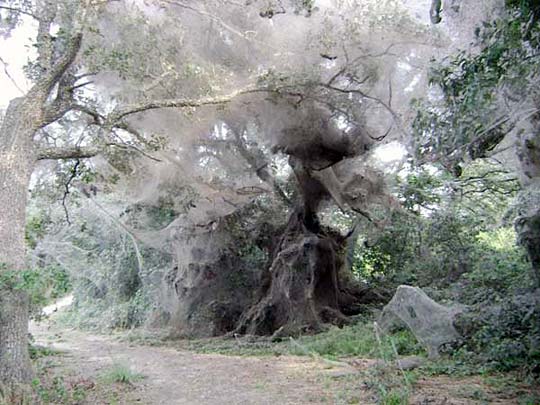
Now this is a real social web!


In case you haven't heard this story already, check out The spider(s) that ate Texas at the Bug Girl’s Blog. The web is so big it even got covered by National Public Radio on friday afternoon.

Read More...

ShareThis

Darwin's tweets

Recent ScienceBlogs Posts on Peer-reviewed Papers

Current Readers

counter

  © Blogger template Brooklyn by Ourblogtemplates.com 2008

Back to TOP