Showing posts with label photo. Show all posts

Thursday, March 26, 2009

Shy flowers on a cold spring morning in the Sierra foothills (Friday Photo)

Even as California continues to experience a drought, and the region is facing water shortages, this winter-spring has brought just enough precipitation to allow the wildflowers to blanket the Sierra Nevada foothills in a riot of colors the like of which I haven't seen in the five years I've lived in this area. My colleagues and students have noticed an increasing grumpiness in me these past couple of weeks, and part of the reason is that I really want to be out there in them thar hills traipsing through the wildflowers, not cooped up in the concrete of the Science building (where, to be fair, I have had quite a few glimpses of snowclad hills this spring - but that only makes being in the office worse!)! Why do we have spring break in April in this goshdarned valley, when actual spring has long since passed us by? I know, I know, it probably has to do with a certain religious holiday in early April - but that's a subject of a rant I'll save for another day. For now, this Friday, let me share some of my attempts to capture the fleeting beauty of spring in the Sierra foothills onto a few digital images. I've managed finally to create a Flickr album to collect these images, including this one of a dewy Baby Blue Eyes and some Goldfields (I think) apparently feeling too shy and/or sleepy to face the morning sun (last tuesday) after the equinox weekend's cold snap:

blue and yellow, turning away

Click on the picture to access the entire gallery, which I hope will provide you some relief even at your computer desk. Especially if you've been following the circus of the Texas State Board of Education this week as they've been watering down (to put it mildly) their standards on how science is to be taught in that state. (And please do let me know if I've made any errors of identification - floral taxonomy is not my forte!).

Happy Spring, wherever you are! And I also wish you total blissful darkness - or romantic candlelight - this saturday when we celebrate Earth Hour!

Read More...

Wednesday, October 29, 2008

A Bite of Beta-Carotene for Better Twitterpation

Submitted by Pedro Garcia for Evolution


House Finch.jpgScarlet Macaw.jpgPink Flamingo.jpgAmerican Kestrel.jpg


ResearchBlogging.orgBirds, birds, and more birds, with over 10,000 species of birds well known and classified, one can get an array of different colors which would make even the most non-bird lover’s staring in awe. With some species having such intricate combinations of reds, yellows, greens, and blues, (such as the scarlet macaw of South America) one might ask, “Why do they have such vibrant and magnificent plumage?” (or something along those lines). It’s a well known fact that skin and feather color (yellows and reds) is linked with carotenoids in the body. One well known example is the Caribbean flamingo, known for its brightly reddish/pink color. This species of bird gets its color from the high intake of beta-carotenes obtained from its diet of crustaceans and algae. But why? What good is it to be so brightly colored? One might even think that such bright colors would be a sort of bull’s eye for predators as if saying “Hey, you…the one with the sharp teeth…I’m over here!” Well, in short, it can all be explained by loosely quoting the hip hop song… “it’s all about sex, baby!”


That’s right, ongoing research has been linking brightly colored plumage in birds to…well, sex! This is the not-so-PG stuff that Darwin didn’t really talk about in his book (at least not directly), however it is merely the process of evolution at work. Researchers Negro, et al, (2002), have gone even more in depth concerning the correlation of plasma carotenoid-dependent skin color in relation to sexual selection. Their work consisted of analysis of brightness of color, not in the feathers, but, in the cere, lores, and tarsi of the small falcon the American Kestrel (Falco sparverius) along the time scale of mating season to hatching of offspring. As stated in the article, research has shown that color of plumage in birds does have an effect on sexual selection in brightly colored birds (Negro, 2002). As stated earlier, the brightness of plumage (specifically reds and yellows) is dependent on the amount of carotenoids found in the body; and beta-carotene is taken in directly from food source. Simply put, female birds choose the male with the brightest plumage because he is the one that can successfully obtain the most food, thus passing on the “better” genes to the offspring. As said before, it’s the process of natural selection at work.


Although there has been much research on sexual selection and plumage color, this article delves in even further and tries to find a correlation with skin color in birds as a function of sexual selection. It seems that, as hypothesized before, there is a brighter skin hue during the mating season. However, what came next seemed to be of even greater interest. It seems that, at least among American Kestrels, the “brightness” of the skin color began to fade as soon as the mating season ended. This was directly linked with a reduction in plasma-carotenoid levels (Negro, 2002). It is believed that the reduction occurs as a trade-off between sexual selection (during mating season) and maintaining better health (post-mating season). Since the bright coloration is no longer needed after mating, it would seem that a reduction in plasma-carotenoids would allow for the carotenoids to assist in other health-related body functions (such as anti-oxidants aiding in the reduction of oxidative damage by free radicals).


One concern I have with research is the methodology used for the experiments. All subjects were captive Kestrels from the “Avian Science and Conservation Center of McGill University, Canada…” which were fed a consistent diet of “…day-old cockerels” which were carotenoid-rich (Negro, 2002). This brings up my concern that the Kestrels were not mimicking natural processes, thus adding, in my eyes, a great amount of tolerance and bias to the results. It should be noted that the author does state that they have “previously shown that variation in plasma carotenoids during the mating period (April) was not attributable to diet, parasites or androgen levels” (Negro, 2002). Ideal settings that would eliminate this tolerance would include plasma collection of marked Kestrels in the wild throughout a series of mating and fledging seasons.


References

J. J. Negro, G. R. Bortolotti, J. L. Tella, K. J. Fernie, D. M. Bird (1998). Regulation of integumentary colour and plasma carotenoids in American Kestrels consistent with sexual selection theory Functional Ecology, 12 (2), 307-312 DOI: 10.1046/j.1365-2435.1998.00176.x


Read More...

Wednesday, August 27, 2008

Holy magnetic cow!!

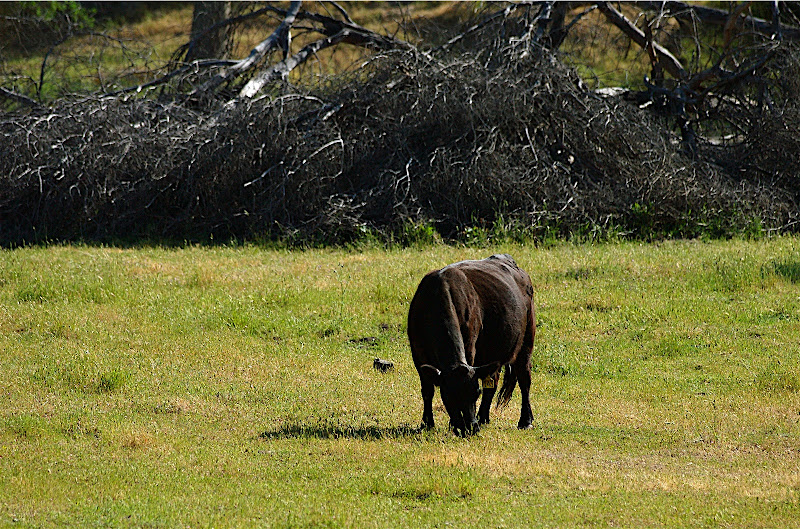
ResearchBlogging.orgFile this one under the "who woulda thunk it?", or "why didn't I think of this?" or simply "whaaa...?!" categories! Quick, can you tell which way is north in this picture?


Do you think of asking the cow for directions? Why not? For it seems that cow probably knows which way north is!


You know, these big dumb-seeming large mammals you pass by every day, these big walking, grazing cheese-producing happy cows dotting the picturesque landscapes of California's grassy hillsdes, or their scrawnier but holier cousins clogging up traffic throughout India? Well, there is more to them than meets the eye - in fact this curious tidbit about their natural history seems to have escaped notice from even the keenest cowboy, cattle-herder, animal husband (I'm not sure if that's what one calls someone practicing animal husbandry - is it?), or drunken late night cow-tipper, throughout history.


It took some creative but fairly straightforward analysis by German scientists of satellite imagery now available via Google Earth to discover that cows, while grazing or resting, chewing cud tend to orient their bodies along the magnetic north-south axis!! And its not just cows, deer also appear to do the same! How cool, and odd, and curious is that?! And what a clever application of Google Earth imagery? This team simply measured the orientation of 8510 cows in satellite images of 308 pastures across the globe, and found that over two-thirds of the animals orient themselves along a north-south axis!! Apart from simply asking the question (who woulda thunk?), the analysis was careful enough to account for local variation in magnetic fields, and shows that the animals orient according to the local field, not geographic north!


Which raises all kinds of interesting questions worth following up on, some of which you can read about in the original PNAS paper published in an early online edition this week, and in this Los Angeles Times article covering it. Here's the abstract from PNAS:


Magnetic alignment in grazing and resting cattle and deer


Sabine Begall, Jaroslav Červený, Julia Neef, Oldřich Vojtčch, and Hynek Burda


Abstract


We demonstrate by means of simple, noninvasive methods (analysis of satellite images, field observations, and measuring “deer beds” in snow) that domestic cattle (n = 8,510 in 308 pastures) across the globe, and grazing and resting red and roe deer (n = 2,974 at 241 localities), align their body axes in roughly a north–south direction. Direct observations of roe deer revealed that animals orient their heads northward when grazing or resting. Amazingly, this ubiquitous phenomenon does not seem to have been noticed by herdsmen, ranchers, or hunters. Because wind and light conditions could be excluded as a common denominator determining the body axis orientation, magnetic alignment is the most parsimonious explanation. To test the hypothesis that cattle orient their body axes along the field lines of the Earth's magnetic field, we analyzed the body orientation of cattle from localities with high magnetic declination. Here, magnetic north was a better predictor than geographic north. This study reveals the magnetic alignment in large mammals based on statistically sufficient sample sizes. Our findings open horizons for the study of magnetoreception in general and are of potential significance for applied ethology (husbandry, animal welfare). They challenge neuroscientists and biophysics to explain the proximate mechanisms.


So what's the underlying mechanism cows use to sense the magnetic field? Do they also have magnetic particles in their brains like many better studied migratory species known to orient magnetically? Why do they do this? Domestic cows are not, of course, migratory any more (at least not on their own), so what might they gain by orienting magnetically? Or is this simply a vestige of their evolutionary history, from ancestors who actually put that magnet to use? And do they prefer to point their heads north or their behinds? The satellite photos are not sharp enough to tell apparently, so answering that may require some ground-truthing! Opens up a whole new line of research, doesn't it?


And as for why so many humans who have spent much time with cows failed to notice this uncanny magnetism, here's a priceless quote from the LA Times, from a dairy farmer right here in the Central Valley, no less:


Asked whether he had ever observed such behavior in cows, dairy farmer Rob Fletcher of Tulare, Calif., said, "Absolutely not." But, he added, "I don't spend a lot of time worrying about stuff like that."


I suspect, however, that the last laugh belongs to the cows, as only Gary Larson could have guessed! Remember this from his insightful pen?


FarSideCownCar.gif


That's why it took satellites to notice this particular behavior! What else have the cows been up to then?


Reference:


Begall, S., Cerveny, J., Neef, J., Vojtcch, O., Burda, H. (2008). Magnetic alignment in grazing and resting cattle and deer. Proceedings of the National Academy of Sciences DOI: 10.1073/pnas.0803650105


Read More...

Monday, August 25, 2008

Welcome, Evolution class of Fall 2008!

dragonflies in loveHere we go again! Actually, I guess its just me going again - but all you new students of BIOL 105 are embarking on a brand new journey through Evolution, right? I hope you are excited! Especially since you are the first class of the Sesquicentennial Year of Natural Selection!

This blog will be our secondary channel of communication (the classroom being the primary one). I use this medium to share any cool evolutionary discoveries I read about, outside of the textbook. There are also bits of not entirely relevant, but hopefully enjoyable fluff scattered about. And you students too will have opportunities to share your own readings and writings through this blog during the course of this semester. Feel free to poke around here, look through the archives, and see what your predecessors in this class wrote about.


Welcome back to the new academic year! I'll see you in class soon.


Read More...

Tuesday, May 6, 2008

Samurai Crab

Submitted by Nasir Sadeghi.


heikegani.jpg


genji20crab20faceqjprevzk6.jpg


Heikegani crabs of Japan have markings on their carapace that resemble a human face, the face of a medieval samurai to be exact. It is locally believed that these crabs are reincarnations of the spirits of the Heike warriors defeated at the Battle of Dan-no-ura as told in the >Heike Monogatari ("The Tale of the Heike"). It is believed that when caught, these crabs are not eaten, but are thrown back into the water because if they're resemblance to a human face. This raises a question: how could the face of a samurai end up on the carapace of a Japanese crab?


It is thought that from the first crab that had a carapace shaped remotely like a human face, it was thrown back into the water, and thus humans were applying artificial selection on the crabs. Fishermen were probably reluctant to eat a crab with a human face, and because of this, these crabs were selected for, and thus this phenotype was passed down the hereditary line. Over the generation of interaction between humans and these crabs, the crabs with patterns resembling the samurai face preferentially survived. None of this involves the crab making a conscious decision about its carapace pattern (Lamarkian Evolution), but it is the artificial selection being imposed on the crabs from the outside that is responsible for this phenomena.


Read More...

Tuesday, April 29, 2008

The trouble with eating things with claws

... is that they can get you even after you've killed them! If you need another reason to stay away from eating chicken-feet, check out this photo: they might be kinda hard to swallow!


080424-hawk-claw-02.jpg


Note, however, that this is not a case of a bird trying to fight its way out of they hawk's gullet - more an accident when you try to swallow sharp objects that can rupture your crop and burst through your skin! This poor little Sharp-shinned Hawk had properly killed the small bird it was trying to eat, but appears to have bitten off more than it could swallow, resulting in a rather bizarre death. Can we nominate this hawk for a Darwin Award?


[From Dead Hawk's Last Meal Claws Partway Out]


Read More...

Thursday, April 10, 2008

Remember when snakes had legs?

ResearchBlogging.orgCan't remember? Well, it was a while back, and fossils of legged snakes have been hard to come by. Another one of those pesky gaps in the fossil record, although we know from the precious few specimens we have and a whole range of other evidence that snakes evolved from lizards that had legs. Not just that - loss of limbs is a recurring theme among a bunch of squamate lineages with snakes being the most prominent. And one of the problems with fossils, especially when you don't have many specimens to play with, is that its not easy to study anatomical detail without risking destroying the fossil! And without such detail, it is difficult to reconstruct exactly what might have happened in the evolutionary trajectory from lizards to snakes. What to do? Well, high energy physics to the rescue, of course!


As reported today by the BBC, a new study used intense X-rays - with much higher energy, one guesses, than found in your dentist's office - to examine one such rare snake fossil to look beneath the surface of the fossil and take a picture of a hidden leg! Here's an excerpt (with photo below the fold):


Researchers at the European Light Source (ESRF) in Grenoble, France, used intense X-rays to confirm that a creature imprinted on a rock, and with one visible leg, had another appendage buried just under the surface of the slab.


"We were sure he had two legs but it was great to see it, and we hope to find other characteristics that we couldn't see on the other limb," said Alexandra Houssaye from the National Museum of Natural History, Paris.


The 85cm-long (33in) creature, known as Eupodophis descouensi, comes from the Late Cretaceous, about 92 million years ago.


Unearthed near the village of al-Nammoura [in Lebanon], it was originally described in 2000.


Its remains are divided across the two interior faces of a thin limestone block that has been broken apart.


A portion of the vertebral column is missing; and in the process of preservation, the "tail" has become detached and positioned near the head.


But it is the unmistakable leg bones - fibula, tibia and femur - that catch the eye. The stumpy hind-limb is only 2cm (0.8in) long, and was presumably utterly useless to the animal in life.


Still how much can one do with one such tantalizing glimpse from a single fossil?


_44555496_snake_fossil466x400.gif
The top picture is a synchrotron view of the visible snake leg;
Synchrotron light in the bottom view illuminates the hidden limb


"Every detail can be very important in establishing the great relationships and that's why we must know them very well," explained Ms Houssaye.


"I wanted to study the inner structure of different bones and so for that you would usually use destructive methods; but given that this is the only specimen [of E. descouensi ], it is totally impossible to do that.


"3D reconstruction techniques were the only solution. We needed a good resolution and only this machine can do that," she told BBC News.


That machine is the European Synchrotron Radiation Facility. This giant complex on the edge of the Alps produces an intense, high-energy light that can pierce just about any material, revealing its inner structure.


For this study, the fossil snake was clamped to an inclined table and rotated in front of the facility's brilliant X-ray beam.


In a process known as computed laminography, many hundreds of 2D images are produced which can be woven, with the aid of a smart algorithm, into a detailed 3D picture.


The finished product, which can be spun around on a computer screen, reveals details that will be measured in just millionths of a metre.


The E. descouensi investigation shows the second leg hidden inside the limestone is bent at the knee.


"We can even see ankle bones," ESRF's resident palaeontologist Paul Tafforeau said.


"In most cases, we can't find digits; but that may be because they are not preserved or because, as this is a vestigial leg, they were never present."


Cool, huh? The only uncool part of the story is that the BBC does not tell us where this is being published in the peer-reviewed literature! I suppose we'll know soon enough. Meanwhile, check out these earlier papers, linked above:


Apesteguí­a, S., Zaher, H. (2006). A Cretaceous terrestrial snake with robust hindlimbs and a sacrum. Nature, 440(7087), 1037-1040. DOI: 10.1038/nature04413


Wiens, J.J., Brandley, M.C., Reeder, T.W. (2006). Why does a trait evolve multiple times within a clade? Repeated evolution of snakelike body form in squamate reptiles. Evolution, 60(1), 123. DOI: 10.1554/05-328.1


Read More...

Friday, March 21, 2008

Friday photo: ponder the evolutionary ecology of this job...

web.jpg


Seems somehow apropos towards the end of spring break week, no?


(Click on image for larger version - captured at McKenzie Preserve; © Madhusudan Katti, 2007)


Read More...

ShareThis

Darwin's tweets

Recent ScienceBlogs Posts on Peer-reviewed Papers

Current Readers

counter

  © Blogger template Brooklyn by Ourblogtemplates.com 2008

Back to TOP