




On Oct. 1, we had a successful launch to the Central Valley Café Scientifique, our new forum for informal conversations about science, centered around topical presentations by area scientists. The first event, where Paul Crosbie talked about what's killing Sea Otters drew a sizeable crows of science enthusiasts, almost overflowing Lenny's Bistro Deli. If you are in the vicinity next Monday, I would like to invite you to our next meeting, a post-Halloween / Day of the Dead postmortem special. Here's the announcement:
Central Valley Café Scientifique presents:
"Over My Dead Body: A Coffeehouse Discussion"
by
Dr. Kevin Miller
Forensic Biochemist, Chemistry Dept. CSU-Fresno
Monday, November 5, 2007, from 6:30-8:30 PM
Lenny's Bistro Deli in River Park (across from Edwards' cinemas)
For further details, visit: http://www.valleycafesci.org/
Wednesday, October 31, 2007
Café Scientifique - El Dia De Los Muertos


Sunday, October 7, 2007
Teaching science in a benighted valley

Why is it that a wonderful week which saw the successful full-house launch of the Central Valley Café Scientifique on Monday night, and ended with a stimulating Saturday morning workshop on Understanding Evolution organized by the Fresno Unified School District is brought crashing down on Sunday morning by the Fresno Bee with this dreck splashed on its front page?? Pardon me, but my scientist colleagues (and I) from CSU-Fresno and science teachers from FUSD, have worked our asses off (with help from our administrators and civic leaders), to keep science in the forefront of the cultural discourse in the Central Valley. Especially this past week which felt pretty rewarding last night! Yet the Bee does not think even the Café Scientifique, of which they have been made aware multiple times by several of us and even the university, merits not one lousy little paragraph of coverage - but some local schoolteacher's search for Bigfoot (yes, you read that right!) merits full frontal coverage??!! What is wrong with this scenario? Why are these demons still haunting this valley?
I had just woken up from what I thought had been a well-earned night of sleep - the first full 7-hours of sleep I've had in a week that saw the above events and my wife's successful Ph.D. thesis defense (also in the sciences - she studied the nocturnal prosimian primate Slender Loris) sandwiched in between - only to be smacked squarely in the face by the Bee and its biigfoot story. Please excuse me if I feel like crawling straight back into bed now...
I swear, some days, its just so damn hard to keep that candle lit in the dark, Carl...!
Monday, September 10, 2007
And you thought your last flight was looong!
Check out this annual commute, suffered by that long-distance migrating champion, the Bar Tailed Godwit (Limosa lapponica). As reported on the Asia-Pacific Shorebird Network, one of these Godwits has just been observed making a non-stop flight of 11,570 Km from Alaska to New Zealand. The female known only as E7 (the name is Godwit; Bar-tailed Godwit... etc.) flew for 8 days and 12 hours clear across the Pacific (not even stopping at Hawaii or Fiji en route!) before arriving, on September 7, close to where it was tagged last February at Piako in New Zealand. This is one of the coolest results of new satellite tracking technology that is allowing such extreme flights to be monitored. You can even watch the whole flight path on your computer if you have Google Earth - just download the kmz file for an interactive version of the image below.
The kmz file has data from all birds followed in this project, allowing you to trace movements of individual birds, and isolate ones of interest, as I did above. You will also be able to follow future movements (e.g., see how and when the other birds make it down to NZ) as long as the transmitters are active, and someone is updating the database online.
Until now, the evidence that these birds actually flew back across the Pacific non-stop was indirect and circumstantial (Gill et al 2005). As described in that paper, it took much greater detective work to follow the trails of these birds, piecing together information on when and where different kinds of godwits had been seen, comparing occurrences in spring vs. autumn, and using flight simulation models to estimate if they could do such long-distance flights. And their conclusion was that the birds hewed closer to shore during spring (northern hemisphere spring), stopping to refuel at various depots along the way, but took a direct route across the Pacific in autumn (northern). Well, we can put all the detective tools and models aside and celebrate their accuracy in predicting what we now know: at least this one female (E7) actually did it last week, flying solo across the length of the Pacific - even weighed down with a satellite transmitter! I wonder how much faster it would have been if it didn't have that added load - but we can't know that! I wish I could track the movements of my beloved little Phylloscopus Leaf Warblers - but that may never happen without much greater miniaturization, perhaps even some nano-technology (like something out of Star Trek), I'm afraid, given that those birds themselves weigh between 7-13 grams.
The Bar-Tailed Godwits, meanwhile, have also been the subject of some really cool research (see Landis-Ciannelli et al 2003) on how their bodies can take the punishment of such extreme flights. It turns out that the internal organs of these birds (and probably most long-distance migrants) are much more flexible that one might imagine: they are literally able to re-arrange their tissues to prepare for and sustain the long flights. And the tissue-reorganization is quite dynamic. First, the digestive organs (stomach, liver, kidneys, intestines) show considerable growth (hypertrophy) either before autumn migration, or more quickly, at stopovers en-route during spring migration (why do they stop during spring, but not autumn?), which makes sense as they need to load up on fuel for the flight. But its not just fuel they are adding for the next phase, for in addition to extreme fat loads, they also bulk up their flight muscles, which reach peak mass just before departure. Meanwhile, as fuel reserves and muscles build up, the intestines shrink, atrophying to minimal levels, presumably reducing extra baggage for these long flights: these birds are literally jettisoning (or rather repackaging) as much cargo as they can, from everything except the engines (flight muscles) and fuel tank (fat reserves)! How cool is that! Talk about breaking your tooth-brush in half to cut down your backpack weight for a long climb...
A consequence of losing all that gut mass is that, upon arrival (either at refueling stops or eventual destinations) these birds are not only exhausted, but they even lack the capacity to eat and digest a proper meal. They first have to re-grow those intestines to be able to process any food they might find. So, if you live along coasts where migrants routinely make landfall after long oceanic flights, and come across exhausted birds landing in unlikely places (e.g., hummingbirds at off-shore oil-rigs in the Gulf of Mexico; Indian Pittas turning up in the middle of Bombay), and want to rescue them, perhaps you should pause before trying to (force-)feed the birds, for they may not have the ability to digest any food at all. And it can take 24 hours or more for the guts to regrow, as tissue is being reallocated from elsewhere (muscles?) to intestines. Which may be why these birds appear particularly vulnerable at that stage.
And what about that question I raised earlier: why do these Godwits make stops during spring, but not autumn migration? I think it has to do with their need to be the first ones on the breeding grounds to maximize breeding success, and uncertainty about conditions on the northern breeding grounds: it pays to get to the breeding grounds early enough, but not too soon, if you know what I mean. In addition, spring migration is all about breeding, another energetically demanding act, for which you have to have some reserves available; in autumn on the other hand, all you have to do is to get to the wintering ground with the arctic cold chasing yout tail, and focus on staying alive through the next few months for another shot at the reproductive lottery. This sets up different selection pressures on the two migratory phases, resulting in different strategies. It also sets up differences between males and females: in spring, it is usually the males who are in a greater hurry to get up and establish breeding territories before females show up; females (like E7), on the other hand, need to conserve more resources to cover their higher energetic/nutritional demands. And ongoing work should help us test and understand some of these ideas better.
Meanwhile, I'll think twice before complaining about the stiffness of my body when I fly across the Pacific en-route to India next time.

Thursday, September 6, 2007
It started 160 million years ago

Here's the tantalizing tidbit tracing the chain of events from the abstract of the Nature paper:Fragments produced by the collision were slowly delivered by dynamical processes to orbits where they could strike the terrestrial planets. We find that this asteroid shower is the most likely source (>90 per cent probability) of the Chicxulub impactor that produced the Cretaceous/Tertiary (K/T) mass extinction event 65 Myr ago.
That Nature link above gives you the abstract, with the rest hidden behind a pay firewall, of course (and we don't yet have Nature available online here at CSU-Fresno!). I don't understand why Nature doesn't make their editorials and News & Views features more available, but there is a brief editorial summary of this paper here. And Bottke's website may have the reprint up at some point, but meanwhile you can start by listening to that NPR story.
Monday, September 3, 2007
Kinky? Gross? But they're just beetles...

Female Callosobruchus maculatus mate when they are thirsty: resource-rich ejaculates as mating effort in a beetleDon't tell me you would pass up that tantalizing title if you found it on the newsstand! But if you still find it dry and academic, you can always turn to some friendly science blogger to pre-digest it for you: Jake Young adds good background with a video so you can see what bruchid beetles are, while Mo the Neurophilosopher offers the truly scary photo of male genitalia in these beetles.
Its all "about nuptial gifts (basically, females will trade sex for drinks)" as pondering pikaia puts it, although it seems to me these females have a rather rougher bargain than that - just look at that penis!
Ain't evolution cool?
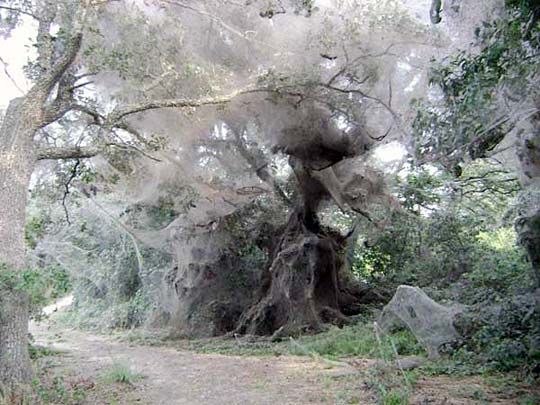
Now this is a real social web!
In case you haven't heard this story already, check out The spider(s) that ate Texas at the Bug Girl’s Blog. The web is so big it even got covered by National Public Radio on friday afternoon.
Friday, August 31, 2007
Cafe Scientifiqué comes to the Central Valley!

The full email announcement is below the fold, and I've set up a website with additional information at valleycafesci.org, and a Google Group for email announcements.
Dear Friends and Colleagues,
Welcome to an exciting new forum for talking about science, engaging in dialogue about current science with non-scientists, and generally raising the science culture in our valley: the Central Valley Cafe Scientifiqué!
What's a Cafe Scientifiqué? I think of it as a science/nerd equivalent of a poetry reading, or Fresno's Art-Hop events, or the philosophers' Socrates Cafes. It is a free-wheeling discussion of a science topic, centered around a presentation from a scientist, in an informal setting outside the normal channels of academia. Meetings are therefore usually held at a local cafe or pub where anyone is welcome to wander in (including, especially, people who don't normally seek out science seminars or lectures on campus), listen to a brief science talk, and engage in thought-provoking conversation over food and drinks. These cafes started in the UK a decade or so ago, and have spread throughout the world - our closest ones are several in the Bay area.
Our Cafe Scientifique will meet on the First Mondays of every month starting on October 1, 2007:
Venue: Lenny's Bistro Deli, in River Park, north Fresno, across from the movie theaters.
Time: 6:30-8:30; with the main presentation starting around 7:00 followed by discussion.
First topic: Cute, cuddly, and dead - so what's killing sea otters?
Speaker: Dr. Paul Crosbie, Biology Department, CSU-Fresno
Please visit our website
Please share this announcement with anyone you think might be interested. We look forward to having you there for some good conversations!
Friday, August 3, 2007
And to make it fair and balanced, here's Dawkins on the Colbert Report
Colbert interviewed Richard Dawkins last fall (Oct 17, 2006).
Here's Part 1 of the interview:
and Part 2:
Darwin's Einstein? Colbert Reports - You Decide!
Should all science begin with looking for how to limit a theory?

 Posts
Posts


