Wednesday, February 11, 2009

David Attenborough on Darwin and Evolution

Sir David Attenborough was interviewed on several British TV channels in anticipation of his latest documentary, broadcast on BBC lon Feb 1. I just found a couple that you might enjoy.


I'll find "Charles Darwin and the Tree of Life" to share soon also.


Read More...

Tuesday, February 10, 2009

Darwin Aloud

From my email this morning, here's another fun way to participate in celebrating Charles Darwin's bicentennial - by videotaping yourself reading some of the most poetic passages of his most famous work:


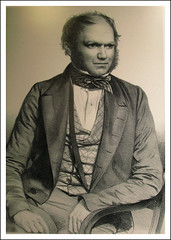
Charles Darwin image for cut out

Darwin Day is a world-wide tribute to a great scientist who changed forever our perception of the human species and the nature of life. This year, the Center for Inquiry is honoring Darwin with a special video project:


Darwin Aloud


This Darwin Day, we're asking people all over the world to shoot video of themselves reading from the poetic last chapter of The Origin of Species while standing in front of famous landmarks in their countries. Then, as a tribute to Darwin's Theory of Evolution, the grand unifying concept of biology that unifies all of us and all life on Earth, we'll collect all this video and assemble the footage into a film dedicated to Darwin and honoring his accomplishments.


"Despite overwhelming evidence in support of evolution, Darwin's theory has seen a lot of resistance and even hostility, especially in the past few decades," said James Underdown, Executive Director of CFI Los Angeles and creator of the project. "We in the pro-science community want to make it clear that the whole world supports Darwin's idea, regardless of background or location."


To learn more about Darwin Aloud, including tips on how best to read, film, and submit your segment, please visit www.cfiwest.org/darwinaloud. You can even download a Letter to your Friends, telling them about Darwin Aloud and inviting them to participate.


We don't lack for significant landmarks around Fresno, so how many of you are interested in participating in this?


Read More...

On the Origin of Species... read by Richard Dawkins

For those of you in my Evolution class winding your way through Darwin's incredible tome (especially those of you struggling a bit with the prose), this might help: an audiobook version abridged and read wonderfully Richard Dawkins. Here's the review from Times Online:


[Dawkins] excised the out-of-date, disproved and irrelevant bits (while being amazed at ‘how much Darwin got right') to produce a lively version of the great work that gave us the term ‘evolution'. You have to concentrate pretty hard sometimes, but close attention reveals a dazzling talent for the observation and analysis that formed the theories. Darwin's marvellous descriptions cover the gamut of living species that, be they pigeons, spiders or flowers, are engaged in ‘the universal struggle for life'. ‘Natural selection is a power incessantly ready for action' in this continuing process. Dawkins reads engagingly, and the whole effect is like David Attenborough without the pictures.

[via On the Origin of Species by Charles Darwin, read by Richard Dawkins]

Just might make your own reading of the (unabridged) book more enjoyable. You can listen to a 5-min excerpt for free on the Times page, and download via iTunes for less than the price of a movie ticket! What a bargain. Of course, an unabridged audiobook version is also available - read by David Case, rather than Dawkins.


Enjoy!


Read More...

Monday, February 9, 2009

Blogging the Voyage of the Beagle

Charles DarwinWhat if Darwin had access to today's technology, especially the internet and all this web 2.0 stuff? As it is, he was an incredibly well-connected / networked guy for the first half of the 19th century, corresponding with all manner of people from all over the world, from top scientists of the day to breeders of dogs and pigeons, and even amateur beetle-fancying shoe-salesmen. Would he have been more or less productive with access to blogs/facebook/twitter/friendfeed etc? We'll never know... but we can try to map his prodigious correspondence and writing onto these modern devices and re-create a web 2.0 version of Darwin, can't we? Has someone created a facebook page for him yet? I dunno, but it might just be a matter of time. I just discovered (thanks, Bora) the The Voyage of the Beagle as a blog! This is how he would have done it, surely - blogging his travels as modern-day explorers do. And, of course, if Darwin blogged, surely he would've micro-blogged, on twitter! So if you are a twitterer, you can follow Charlie's twitter stream as well!


Read More...

Thursday, February 5, 2009

On Darwin, Lincoln, and modern life

Struggling to fall asleep last night with this nasty cold-flu thing that has me in its grips for the past several days, I happened upon the Charlie Rose Show on PBS. I'm not a regular viewer of this show, what with Rose's penchant for giving so much air time to that airhead pundit Thomas Friedman (64 appearances!!! really need that much hot air, Charlie?!). But Rose does get some excellent guests from time to time, and provides space for a deeper conversation than the typical tv talk-show - one has to give him that! And last night was just such an occasion, for Charlie had on the New Yorker writer Adam Gopnik, discussing his latest work: "Angels and Ages: A Short Book About Darwin, Lincoln, and Modern Life", which sounds absolutely fascinating. I was pleased to discover just now that the Charlie Rose show offers entire programs online, allowing me to embed this interview below. The first half is what really gripped me, with Gopnik talking about Darwin and Lincoln — men born in a cosmic coincidence on February 12, 1809 — as embodying the twin pillars of the modern world: science and liberal democracy. So true! This is really well worth listening to when both these figures loom so large in our consciousness in this month of their bicentennial. And you Evolution students really need to pay attention when Gopnik describes Darwin's writing style! The second half is about a more recent interesting figure, the late writer John Updike. Here, watch the whole thing:


Now I've got one more "short" book to add to my reading pile - terrific!


Read More...

Wednesday, February 4, 2009

The Evolution Will Be Televised

And may be viewed by those of you fortunate to be subscribed to the National Geographic TV channel via cable/satellite. The above is the tagline NatGeoTV is using to promote their celebration of Darwin's 200th birthday. Click on the image here for the program, which kicks off this Sunday, Feb 8th with a new 3-part series "Morphed".


They will also run a live-blog starting an hour before Morphed, and are already inviting questions in their Evolution forum. Then on the 10th, they're showing Darwin's Secret Notebooks, and Explorer: Monster Fish of the Congo. All of this looks pretty exciting, and I will try to post previews/reviews as time permits over the next couple of weeks. I may even try a bit of live-blogging here if enough of the students are interested (so let me know!). And if you don't have access to NatGeoTV, find someone who does and might tolerate you on their couch for a few hours! Meanwhile, the complete announcement I received in my email, with links to video clips, is below the fold:


Below are brief descriptions of each of our five Darwin-related programs, and attached is the full press release for your information.


MORPHED


Sunday, February 8, 2009 at 8PM – 11PM ET/PT, with Live Blogging Event at 7PM ET/PT


http://natgeotv.com/morphed


Using advanced CGI, forensic examination of the latest fossil evidence and 3-D, biomechanic animation, Morphed brings ancient creatures back to life and recreates the most dramatic forces impacting their evolution — from natural disasters to competitors and brushes with extinction.  Also, during the first hour of Morphed, join a panel of experts in the fields of biology, molecular science, and theology for a Live Blogging Event to discuss the topic of evolution and its significance in today's science community, education, and its relationship to religion and theology. Be sure to submit your questions in advance at http://ngccommunity.nationalgeographic.com/ngcforums/evolution/ and log in on Sunday, February 8 at 7 PM ET/PT! The three back-to-back episode premieres include:


MORPHED: FROM DINOSAUR TO TURKEY digs 230 million years back into the fossil record to witness the emergence of the first dinosaur and follows different dinosaur species as they respond to changes in the earth's environment.


Video "Dinosaur Descendents" – Next Year at Thanksgiving dinner, imagine you're eating a dinosaur. You won't be far from the truth:http://channel.nationalgeographic.com/channel/videos/feeds/cv-seo/Animals--Nature/All-Videos/Prehistoric-Turkeys.html


MORPHED: WHEN WHALES HAD LEGS examines the environmental pressures that turned a wolflike creature that hunted in shallow waters into a leviathan of the seas.


Video "Ancient Whale Bones" – In the plains of Pakistan, archaeologists discover clues to help solve the mystery of how land mammals became whales:http://channel.nationalgeographic.com/channel/videos/feeds/cv-seo/Animals--Nature/All-Videos/Archaeologists-Find-the-Missing-Whale-Link.html


MORPHED: BEFORE THEY WERE BEARS travels back 30 million years to watch the bear's doglike ancestor climb down from the trees of central Europe and set out on a journey that spanned the planet.


Video "Giant Historic Bear" – In the struggle for survival, the giant short-faced bear evolved into a towering kiling machine:http://channel.nationalgeographic.com/channel/videos/feeds/cv-seo/Nat-Geo-Wild/All-Videos/Ancient-Predators-in-Beringia.html


DARWIN'S SECRET NOTEBOOKS


Tuesday, February 10, 2009 at 9 PM ET/PT


http://natgeotv.com/darwin


Using Darwin's own diary and field notes as a travel guide, National Geographic Channel retrace Darwin's expedition beyond the Galapagos to uncover the forgotten evidence that inspired his revolutionary work. We see how fossils in Argentina, seashells in the Andes and fish in the South Pacific helped him cultivate his radical theory of evolution.


Video "Inside Darwin's Mind" – The oddity of flightless birds leads Darwin to question the intentions of the Creator:http://channel.nationalgeographic.com/channel/videos/feeds/cv-seo/Animals--Nature/All-Videos/Darwin-Ponders-Flightless-Birds.html


EXPLORER: MONSTER FISH OF THE CONGO


Tuesday, February 10, 2009 at 10 PM ET/PT


http://channel.nationalgeographic.com/series/explorer/3826/Overview


Join a team of adventurers and scientists and travel deep into the heart of Africa's Congo River Basin in search of an elusive man-sized predator known as the tiger fish.  While locals believe this ravenous relative of the piranha is cursed, scientists believe the fearsome fish may hold the key to understanding the evolution of an extraordinary array of bizarre creatures found throughout the Congo.



Read More...

Do you have a bit of Neandertal in you?

Of course, we undoubtedly share the bulk of our DNA sequence with our long-lost cousins, the Neanderthals. But more interesting is the question of whether our direct ancestors actually ever got it on with the Neanderthals! Was there any nookie... er... horizontal transfer of genetic material between them? That could get really interesting, no? Well, it appears we're getting closer to finding out:


The entire genome of a 38,000-year-old Neanderthal has been sequenced by a team of scientists in Germany. The group is already extracting DNA from other ancient Neanderthal bones and hopes that the genomes will allow an unprecedented comparison between modern humans and their closest evolutionary relative.


The three-year project, which cost about €5 million (US$6.4 million), was carried out at the Max Planck Institute for Evolutionary Anthropology in Leipzig. Project leader Svante Pääbo will announce the results of the preliminary genomic analysis at the American Association for the Advancement of Science annual meeting in Chicago, Illinois, which starts on 12 February.


[via Neanderthal genome to be unveiled : Nature News]


Read More...

Happy 200th Charlie! Darwin's Bulldogs got your back in the valley!!

As we celebrate his 200th birthday here on the Fresno State campus, as indeed worldwide, I am thrilled to share the news that some local friends of Charles Darwin have come together to form a new coalition:


Welcome to the Consortium for Evolutionary Studies at California State University, Fresno.


We are a new interdisciplinary campus entity dedicated to the study of evolutionary topics from multiple scholarly perspectives. The consortium has coalesced on the occasion of the the bicentennial of Charles Darwin’s birth - Darwin Day 2009. The consortium consists of faculty and students from several colleges and departments at CSU Fresno. We invite all interested members of the campus community to join us in the promotion of evolutionary theory, science and reason.


[via Darwin's Bulldogs]


Yes, we are calling ourselves Darwin's Bulldogs, establishing a connection not only to our campus mascot, but all the way back to Thomas Henry Huxley, the original Darwin's Bulldog! We can sure use his inspiration here in the Central Valley as we find ourselves still fighting battles Huxley won long ago in England. (and if you must ask, I made a teeny contribution coming up with that association and that moniker for our group! and designing the website too). We've already announced a series of events for Darwin Day 2009 on the website, and look forward to making this a vibrant interdisciplinary venture on campus. Bookmark the website. Join us in the festivities, and email me if you want to know more about the consortium.


Read More...

Tuesday, February 3, 2009

Evolution as a path to emancipation

One of the worst canards that the creationists like to throw at Darwin is that his theory led directly to the 20th centuries atrocities of Stalin, Hitler and the holocaust. The most egregious and blatant example of this was in Ben Stein's propaganda piece last year. I wonder what these people will have to say to this new perspective on what motivated Darwin to develop his theory of evolution and search for a common ancestor for all human beings, and other species:


"It makes one's blood boil," said Charles Darwin.


Not much outraged the gentle recluse, but the horrors of slavery could cost him a night's sleep.


He was thinking of the whipped house boy and the thumbscrews used by old ladies in South America, atrocities he had witnessed on the Beagle voyage.


The screams stayed with him for life, but how much did they influence his life's work?


Today you can still read of Darwin's "eureka" moment when he saw the Galapagos finches.


Alas, his conversion to evolution wasn't so simple, but it was much more interesting. It didn't occur in the Galapagos, but probably on his arrival home.


And new evidence suggests that Darwin's unique approach to evolution - relating all races and species by "common descent" - could have been fostered by his anti-slavery beliefs.

[via BBC NEWS | Darwin's twin track: 'Evolution and emancipation']

Darwin wrote with considerable feeling about his experiences among the natives of South America, as in this passage from "The Voyage of the Beagle:


"On the 19th of August we finally left the shores of Brazil. I thank God, I shall never again visit a slave-country. To this day, if I hear a distant scream, it recalls with painful vividness my feelings, when passing a house near Pernambuco, I heard the most pitiable moans, and could not but suspect that some poor slave was being tortured, yet knew that I was as powerless as a child even to remonstrate. I suspected that these moans were from a tortured slave, for I was told that this was the case in another instance. Near Rio de Janeiro I lived opposite to an old lady, who kept screws to crush the fingers of her female slaves. I have stayed in a house where a young household mulatto, daily and hourly, was reviled, beaten, and persecuted enough to break the spirit of the lowest animal. I have seen a little boy, six or seven years old, struck thrice with a horse-whip..."


As the BBC article, and the new book, traces some of the less well-known aspects of his life-story, it is worth remembering that Darwin had another, less luminary mentor: a freed slave who taught him taxidermy and likely planted the seeds of longing for the lush tropical forests of distant South America five years before he got the famous invitation to join the Beagle's voyage. During February-April 1826 young Charles spent a significant interlude with:


John Edmonstone, a freed black slave from Guyana, South America, taught Darwin taxidermy. The two of them often sat together for conversation, and John would fill Darwin's head with vivid pictures of the tropical rain forests of South America. These pleasant conversations with John may have later inspired Darwin to dream about exploring the tropics. In any event, the taxidermy skills Darwin learned from him were indispensable during his voyage aboard H.M.S. Beagle in 1831.


Another remarkable chapter from the life of a remarkable man, who was way ahead of his times. Another reason to celebrate the man... but I'm not holding my breath for the creationists to stop vilifying him, much less join the celebration.


Read More...

ShareThis

Darwin's tweets

Recent ScienceBlogs Posts on Peer-reviewed Papers

Current Readers

counter

  © Blogger template Brooklyn by Ourblogtemplates.com 2008

Back to TOP